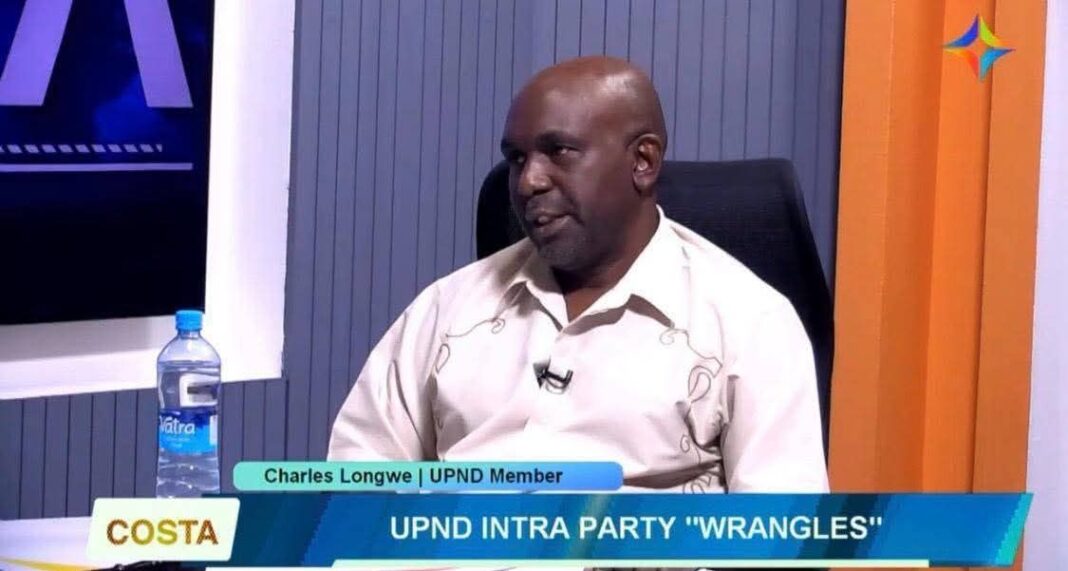
United Party for National Development (UPND) founding member Charles Longwe has lodged a formal complaint with the Judicial Complaints Commission (JCC) against seven Constitutional Court judges, accusing them of judicial incompetence over a ruling that upheld President Hakainde Hichilema’s nomination for the 13 August general election.
In a complaint dated 2 July 2026 and addressed to JCC secretary Brian Gombwa, with a copy to the Chief Justice, Longwe argues that the Constitutional Court’s judgment delivered on 19 June was made per incuriam — a legal term referring to a decision made without proper regard to the applicable law. He contends that the ruling departed from the Constitution and warrants disciplinary review by the Commission.
Rather than seeking to reopen the substantive nomination dispute, Longwe asks the JCC to examine what he describes as professional incompetence in the manner the case was determined.
“The court cannot disregard explicit constitutional provisions during interpretation, as they balance, harmonise, or declare conflicting provisions inoperative,” Longwe states in the complaint.
He argues that there was never any dispute over the existence of the adoption certificate upon which President Hichilema’s nomination was based. Instead, he says the constitutional issue before the court was whether the UPND officials who executed and issued that certificate possessed the lawful authority to do so.
“There was no dispute that the nomination depended on an adoption certificate issued by the UPND. The constitutional question was not whether that certificate existed, but whether the persons who executed and issued it possessed lawful authority to do so,” he writes.
The complaint stems from Longwe’s earlier petition challenging President Hichilema’s nomination, which was dismissed by the Constitutional Court last month. He maintains that the Electoral Commission of Zambia’s own submissions in those proceedings admitted the material facts he had pleaded concerning the nomination process.
According to Longwe, the court also overlooked established electoral jurisprudence showing that questions relating to nomination and candidate eligibility can directly affect the validity of both candidature and election outcomes.
“Constitutional defects affecting candidature and nomination are not cured merely because the Electoral Commission of Zambia subsequently processes or accepts a nomination. The constitutional validity of the nomination remains reviewable by the court,” the complaint states.
Longwe further argues that the legal validity of a presidential nomination cannot be separated from the process through which a political party sponsors and adopts its candidate. In his view, the Constitutional Court erred by limiting the scope of its review under Article 52(IV) of the Constitution instead of examining whether the adoption certificate itself had been lawfully executed.
He maintains that this issue formed the foundation of the entire nomination process and should have been fully determined before the nomination could be upheld.
“If they possessed lawful authority the nomination survives, but if they did not, the nomination fails,” Longwe writes.
He adds that a nomination cannot enjoy greater constitutional protection than the party process from which it originates.
“A defective adoption process cannot produce a valid nomination, and a nomination cannot enjoy greater constitutional validity than the adoption certificate upon which it rests,” the complaint reads.
Although the complaint targets seven Constitutional Court judges, the material made available does not identify them individually. Instead, Longwe asks the Judicial Complaints Commission to examine their conduct in handling the matter as an issue of judicial competence and professional responsibility.
Neither the Judicial Complaints Commission nor the Constitutional Court had issued a public response to the complaint at the time of publication.
Longwe’s petition challenging President Hichilema’s nomination formed part of a series of legal proceedings filed ahead of the August general election, with several cases examining constitutional questions surrounding candidate eligibility, political party adoption procedures and the interpretation of electoral law.
His latest action shifts the matter from litigation over the validity of the nomination itself to a complaint concerning the conduct of the judges who determined the case.
Whether the Commission proceeds with the complaint now rests with the Judicial Complaints Commission, which has yet to indicate whether it will open disciplinary proceedings over the allegations raised in Longwe’s submission.