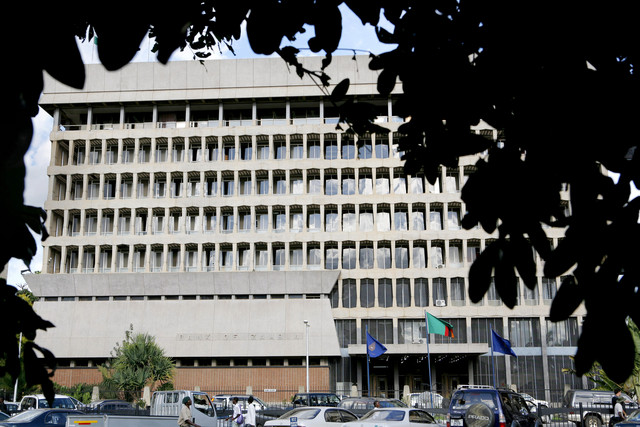
Bank of Zambia has said that unauthorised entities that may be engaged in some form of foreign currency trading must stop such practices as they are contravening the Banking and Financial Services Act (BFSA). In a statement released to the media today, the Central bank said that the Kwacha is the legal tender in Zambia and that all domestic transactions are required to be priced and settled in Kwacha.
Below id the full media statement
NOTICE TO MEMBERS OF THE PUBLIC ON QUOTING AND SETTLING OF DOMESTIC TRANSACTIONS IN FOREIGN CURRENCY
Over the past week, the Kwacha exchange rate has had some relative stability following measures taken by the Bank of Zambia and the Government. However, the Bank has observed with concern that a few business houses are pricing locally traded goods and services in foreign currencies, especially the US dollar.
This practice undermines the macroeconomic stabilisation efforts that are being undertaken. It should also be underscored that inflation in Zambia remains stable and has been declining during the year. Therefore, macroeconomic conditions do not warrant pricing in foreign currency for domestic transactions
The pricing in foreign currencies reduces the price incentive of a depreciation in encouraging businesses to engage in the export or production of goods that are currently imported. Such actions, therefore, work against the necessary adjustments which we all must make. It should be noted that it is not only the consumers that must adjust, but also producers and business houses if we are to successfully diversify our economy and achieve sustainable economic growth and development.
In addition, the pricing in foreign currency implies that businesses are adjusting their prices to reflect the extent of the movements in the exchange rate and yet most of their operating costs are not in foreign currency. The adverse effects of pricing and paying in foreign currencies are mainly felt by the general public rather than business houses as the former has no ready means of hedging against currency depreciation.
Incomes of the overwhelming majority of Zambians are not in foreign currencies. Therefore, these are bound to bear the full impact of quoting prices in foreign currencies more so if compelled to pay in foreign currency for domestically traded goods and services, such as, rentals and school fees.
Furthermore, quoting and demanding payment in a foreign currency amounts to dealing in foreign currencies, a practice that is for authorized foreign currency dealers only. It is also likely to lead to a multiplicity of exchange rates, which may differ significantly from competitive market rates and thereby destabilize the orderly functioning of the foreign exchange market.
If left unchecked, the practice has the potential to increase the demand for foreign exchange and intensify pressure on the exchange rate.
The Bank has guided before, and in line with the Bank of Zambia Act, that the Kwacha is the legal tender in Zambia. Therefore, all domestic transactions are required to be priced and settled in Kwacha. Unauthorised entities that may be engaged in some form of foreign currency trading must stop such practices as they are contravening the Banking and Financial Services Act (BFSA).
In this regard, the general public is hereby advised that regular surveys shall be conducted in order to assess the occurrence of such practices.
The Bank of Zambia commends members of the public who have spoken against this practice and urge the rest to assert their right and discourage the practice of quoting and settling domestic transactions in foreign currencies. Members of the public are also urged to bring to the attention of the Bank of Zambia any entity engaged in such practices.
The Bank of Zambia reiterates that the measures to stabilise the economy will only bear the expected results, if all players in the economy cooperate and work towards that goal.
Issued by
Head – Communications Division
Bank of Zambia
LUSAKA
Web: http://www.boz.zm
Email: [email protected]
September 15, 2015