From a Broken Promise to a Legal Right — Why the UPND’s ‘Education for All’ Policy Marks a Decisive Break with the Past
An analysis of Zambia’s free education journey — 1966 to 2026
By Lee Kambanikwao Ndonyo
The Founding Promise: Kaunda’s Education Act of 1966 — and Its Undoing in the 1980s
Zambia’s first real attempt at free education came almost immediately after independence. President Kenneth Kaunda’s UNIP government enacted the Education Act of 1966, which abolished the racially segregated colonial school system and introduced non-fee-paying registration in public and mission-run schools. For the first time, ordinary Zambian families could send children to school without the direct cost barriers of the colonial era, and primary enrolment scaled steadily through the late 1960s and 1970s as a result.
That founding promise did not survive Zambia’s economic collapse. From the mid-1970s, the country’s copper-dependent economy went into a prolonged crisis, and by the early 1980s, the government budget was in deep deficit and increasingly reliant on the IMF and World Bank, and could no longer sustain free schooling. Under the structural adjustment era, Kaunda’s own government introduced ‘cost sharing’ in education during the 1980s: parents were required to contribute directly to general education funds, on top of desk fees, books, uniforms, and other costs that had previously been carried by the state. The founding free-education promise of 1966 was, within less than two decades, reversed by the very administration that made it.
That reversal set the template for the decades that followed. Rather than a single dramatic decision, Zambia’s education financing became a story of promises made at independence, quietly eroded under fiscal pressure, and only partially restored since 2021.
The Second Attempt: Mwanawasa’s Free Primary Education, 2002
In 2002, President Levy Mwanawasa’s MMD government introduced Free Primary Education (FPE), abolishing tuition fees for grades 1 to 7. It was a genuine milestone, the first time a Zambian government removed the direct cost barrier to primary schooling at scale, and it drove an increase in enrolment in the early 2000s.
However, FPE had a hard ceiling. It stopped at grade 7. From grade 8 onward, the point at which many rural and low-income families lose their children to the education system, school remained fee-based. Secondary education, where the real economic returns of schooling accrue, was left untouched. FPE also arrived without a matching investment in secondary infrastructure or teacher recruitment sufficient to absorb the primary-school bulge it created, a gap successive governments never fully closed.
In short: Mwanawasa’s FPE was a foundation, not a finished house. It proved free education was possible in Zambia, but it left the most consequential grades, 8 through 12, exactly as costly as before.
The Reversal: Free Education Recedes Under the Patriotic Front, 2011–2021
Rather than build on the FPE foundation, the PF decade saw the direction of travel stall and, on some fronts, reverse. Fees at the secondary level persisted throughout PF’s ten years in office. In 2019, the PF government scrapped meal allowances for university students, a decision widely blamed for alienating young Zambians and one the PF never reversed before leaving office.
The pattern that emerges from this period is one of a government that talked about equity in education but did not remove the financial gatekeeping that determined who actually stayed in school. For a majority of Zambian families, where a 2021 estimate put nearly two-thirds of the population living on less than $2 a day, the fee wall at grade 8 and beyond was not an inconvenience. It was the difference between a child finishing school and a child dropping out.
The Break: UPND’s ‘Education for All,’ 2021–2026
Hakainde Hichilema campaigned in 2021 on a single, specific promise: free education from Early Childhood Education right through to Grade 12, not just primary school. Within months of taking office, his government moved to deliver it.
Increased teachers’ salaries; removed school fees in public schools; removed examination fees; removed PTA fees; recruiting 30,000 more teachers… spending over K18 billion on education in our first year.
— President Hakainde Hichilema, on the policy rollout
From January 2022, tuition fees, examination fees and PTA fees were abolished across public schools nationwide, not just to grades 1–7, as under Mwanawasa, but all the way through secondary school. The 2022 education budget of K18.1 billion was, at the time, the largest allocation in five years, representing 10.4% of the total national budget, up from K13.8 billion in 2021 and K13.1 billion in 2020.
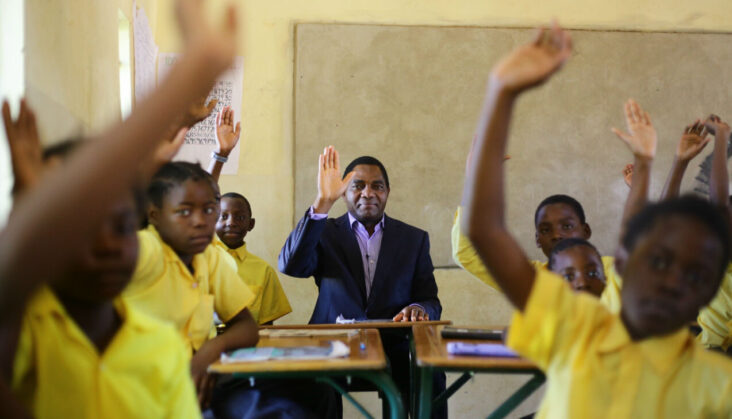
The results, according to the Ministry of Education, have been substantial: more than 2.3 million additional learners entering the school system over four years, more than 41,000 teachers hired, roughly learning space for about 3,000 new classrooms built, and 1.4 million desks delivered, alongside an expanded school feeding programme. In January 2026, Education Minister Douglas Syakalima announced a 70% Grade 12 pass rate, the highest in Zambia’s history.
Then, in mid-2026, the government went a step further than any of its predecessors: it amended the Education Act to make free education a legal right from ECE to secondary level, not an administrative circular that a future government could quietly reverse, but a statute that cannot be undone without an act of Parliament. President Hichilema called it a “historic day for Zambia,” noting the reform had by then drawn 2.6 million children back into classrooms since 2021.
What This Costs — and What Parents No Longer Pay
- 6,295,009 — Total learners, ECE–Grade 12 (2025)
- 13,998 — Public schools covered
- K1.26 billion — Estimated fee value now absorbed by government (illustrative, at K200/pupil)
Zambia’s total enrolment from ECE to Grade 12 in 2025 stood at approximately 6,295,009 learners, spread across roughly 13,998 public schools. If each of those learners had continued paying even a modest cost-sharing contribution of around K200, excluding examination fees, which the government abolished outright and separately, parents nationwide would collectively have been paying out approximately K1.26 billion a year just to keep their children in class. Spread across 13,998 schools, that works out to roughly K90,000 per school, which used to leave household pockets and now does not.
This figure is presented here as an illustrative calculation from current enrolment and a representative per-pupil cost-sharing rate, not a line item copied from a Ministry of Finance ledger, but it captures something the abstract national budget total (K18.1 billion and rising since 2022) does not: the direct, kitchen-table relief a K200-per-child saving represents for a country where a majority of households survive on a few dollars a day. Multiply that by however many children a family has in school, often three, four, or more, and the household-level impact of abolishing fees becomes concrete rather than statistical.
The Sharpest Contrast
- Coverage: Kaunda’s Education Act of 1966 removed fees but was abandoned within two decades. Mwanawasa’s FPE (2002) covered grades 1–7 only. PF (2011–2021) left secondary fees untouched for a full decade, but dropped them to K200. UPND (2021–present) covers ECE through Grade 12, the entire pre-tertiary pipeline.
- Durability: The 1966 promise collapsed under 1980s economic pressure; FPE and PF-era policy remained administrative arrangements, reversible by circular or budget cut. UPND’s free education is now enshrined in the Education Act, a legal right no future government can strip away without going through Parliament.
- Direction of travel: PF’s decade moved backward on youth-facing education support, scrapping university meal allowances in 2019. UPND has moved forward on every front including fees, examination costs, teacher recruitment, classroom construction, feeding, and bursaries (56,000 issued since 2021).
- Scale of relief: An estimated K1.26 billion in annual fee-equivalent costs that used to come directly out of parents’ pockets is now absorbed by the state and on top of a national education budget that has nearly doubled since 2021, from K13.8 billion to over K18 billion and rising.
Why It Matters
Free education has been promised in Zambia before. What sets the current policy apart is not the promise but the completeness of delivery: every grade from ECE to 12, every fee category, tuition, examination, PTA, and now a legal guarantee rather than a political goodwill gesture. Where Mwanawasa built the first floor, and PF left the upper floors locked, the UPND government has, on the record of enrolment, teacher recruitment, and exam performance, opened the whole building and bolted the door shut against future rollback.
For a country where the cost of school has historically decided which children finish and which children do not, that distinction between a legal right versus a policy of the day may prove to be the most consequential education reform in Zambia’s post-independence history.
A note on fair reading
Critics of the policy, including some Zambian educationists, have raised legitimate concerns worth weighing alongside this record: that free education without matching investment in learning quality (teacher-pupil ratios, learning materials, remote-area infrastructure) risks widening access without improving outcomes; that the policy’s fiscal sustainability depends on continued strong revenue collection and donor support; and that some critics have characterised the timing and framing of the reform as politically motivated ahead of elections. These are reasonable points for policymakers and voters to weigh alongside the enrolment and pass-rate figures above.
Sources: Education Act, 1966 (ZambiaLII); Sandlane, The Education System of Zambia After Independence; Lusaka Times; FairPlanet; Mail & Guardian / The Namibian / allAfrica; Open Zambia; Africa Press; Voice of Nigeria; Zambia Ministry of Education (edu.gov.zm) statements by Hon. Douglas Syakalima.