Lusaka Dynamos has insisted that its striker Chris Mugalu who is subject of transfer speculations in the Zambia Super League is still a Dynamos player.
Lusaka Dynamos Club Secretary and Technical Manager Shalala Oliver Sepiso said there is no deal between Lusaka Dynamos and ZESCO United, or any club existing today in Zambia or abroad, on the purported transfer of Mugalu.
“It has always been the policy of Lusaka Dynamos not to respond to social media stories, especially fake news. However we know that it is that time of the year – transfer window – where soccer fans of different clubs will start rumours to either prop their clubs onto some imaginary pedestal or make other clubs appear in bad light,” Sepiso said.
“We therefore wish to state categorically that Chris Mugalu is and remains a Lusaka Dynamos player, and that there is no deal between Lusaka Dynamos and ZESCO United, or any club existing today in Zambia or abroad, on the purported transfer of Chris Mugalu away from “The Elite”. Where there to be any development in this matter, we would have announced that on this page. Mugalu remains an integral part of our plans for the future.”
He added, “Any premature transfer requests being announced by clubs about Lusaka Dynamos players are simply mischief by uncouth officials of those clubs and should be treated with the highest contempt any objective person can master.”
“We have always been open for business and if clubs envy some of our players, they are free to make official approaches.”
Vodacom Group which trades in Zambia as Vodafone has announced the sale of its business unit operations in Zambia, Nigeria and Cote d’Ivoire to Andile Ngcaba’s Synergy Communications.
The transaction is now subject to approval from the regulatory authorities within these markets.
Synergy Communications, a subsidiary of the Convergence Partners Communications Infrastructure Fund announced that it had acquired 100% of Vodacom Business Africa’s operations in these markets.
Convergence Partners, which is owned by Ngcaba, is an investment management firm focused on the technology, media and telecoms sector in Africa.
As the chairman, founder and majority shareholder of Convergence Partners, Ngcaba is also involved in significant new communications infrastructure projects across Africa.
These include Seacom, Intelsat New Dawn, FibreCo, and, recently, a new joint venture with Google to invest in CSquared, a broadband infrastructure company headquartered in Nairobi, Kenya.
This acquisition is a significant milestone in Ngcaba’s vision for Synergy Communication to be a leading provider of cloud and digitally based services in key markets across Sub-Saharan Africa.
Synergy Communications currently has operations in Botswana, Malawi and Mozambique, with flagship investments in Internet Solutions Mozambique, Skyband Malawi and Virtual Business Network Services in Botswana.
Said Ngcaba: “This is an exciting landmark transaction for Synergy Communications, providing us with additional momentum in the delivery of our strategy as a pan-African enterprise digital services provider. Synergy Communications will partner with major global cloud providers and deliver platform-based services to both multinationals and local enterprises.”
Announcing the deal, Vodacom said the transaction supports its enterprise strategy on the continent, which has been refocused to grow and strengthen the core business.
Vodacom says it will no longer directly service global enterprise customers in these three markets, but will continue to operate as a pan-African telecommunications network provider through local relationships like the one with Synergy Communications.
Shameel Joosub, CEO of Vodacom Group, said: “Vodacom has a clear vision for strengthening our position as a leading pan-African business and will work with local service providers like Synergy Communications to grow in these markets. Crucially, Vodacom is not exiting any of the territories related to this transaction and remains focused on continuing to deliver exceptional service to our global and multinational clients in these markets through long-term commercial agreements. To support the sustainable growth of pan-African digital economies and build connected societies, Vodacom will, via local service providers, continue to service clients in each market.”
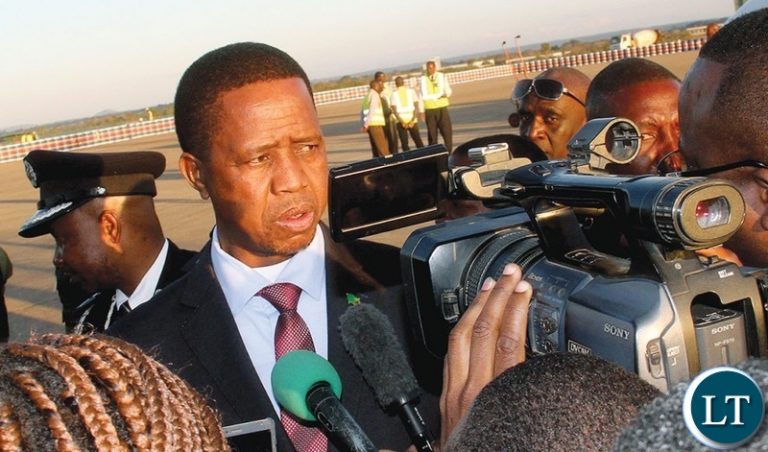
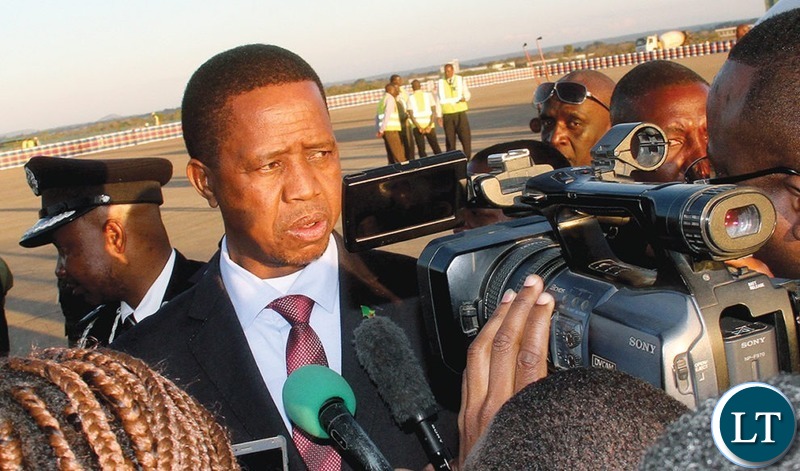
President Edgar Lungu says there is need to unlock the socio economic potential on the Copperbelt Province.
The President says the Copperbelt Province has great potential to contribute to the socio economic growth of the country if well harnessed.
He has noted that the region is a vibrant area and he is hopeful that something different will come out from the investment exposition that is taking place in the area.
The Head of State said this at ZAF Airport Base this morning shortly before leaving for the Copperbelt Province to officially launch the Copperbelt Province Investment Exposition.
President Lungu noted that even though experiences have been different from the investment expositions that have so far been held in other provinces, the results have been desirable.
He said the results for such events depends on the efforts invested in them by individual managers, as well as the provincial administration.
The Copperbelt Investment Expo is running from the 24th of June to 28th of June, 2019 in Ndola under the theme “Broadening the Copperbelt Economy through diversified Investment”.
Meanwhile, PF Secretary General Davies Mwila is in Mwinilunga district of North Western Province to receive hundreds of defectors including headmen from the opposition UPND, MMD and FDD.
Accompanied by members of the Central Committee Annie Kayula, Kebby Mbewe, Eastern Provincial Chairperson Andrew Lubusha and the Deputy Media Director Antonio Mwanza, Mr. Mwila has been received in North Western by the ruling party’s Provincial Chairperson Jackson Kungu and his committee.
And upon arrival in Mwinilunga, the PF Chief Executive Officer will proceed to pay a courtesy call on Chief Kanongesha were he will reassure the traditional leader of government and the ruling party’s commitment to work with traditional leaders in delivering development to the people.
Meanwhile, Mr. Mwila is tomorrow morning scheduled to address the party structures including ward and branch officials in Nchanga constituency of Chingola district on the Copperbelt before addressing the residents on radio.
Among the pertinent issues on the Copperbelt, the Secretary General is expected to reecho the ruling party’s position on the ongoing developments in the mining sector and future plans.
On Friday morning, June 28, Mr. Mwila is scheduled to hold a meeting with Kwacha Constituency officials particularly the Lubwa ward committee concerning the upcoming by-election.
And Mr. Mwila will on Friday evening officiate at the PF Kitwe Women’s League Dinner Dance at Moba Hotel in Kitwe.
One evening three years ago as I was watching the ZNBC main news, a news item appeared that the then Special Assistant to the President for Projects and Implementation Hon. Lucky Mulusa said that Government had identified Ngabwe district as the place where the New Capital City of Zambia would move to.
I was shocked at why Government would do that. Thoughts like what would remain of Lusaka City (the current Capital City of Zambia) were on my mind. My thoughts were moved because I have three properties in Lusaka where I get a good rental return.
My thoughts were only relaxed when both the Minister of Lusaka Hon. Japhet Mwakalombe and the Presidential Spokesperson Mr. Amos Chanda both announced on separate occasions that government had no such intentions and that those were Hon. Mulusa personal views.
However, I started researching why Countries around the world change Capital Cities. I among others found out that Brazil’s capital relocated from overcrowded Rio de Janeiro to the planned, built city of Brasilia in 1961. Another is Nigeria. In 1991 the capital of Nigeria, Africa’s most populated country, was moved from Lagos because of overcrowding. Abuja, a planned city in central Nigeria. In the 1970s, Tanzania’s capital began the move from coastal Dar es Salaam to centrally-located Dodoma.
From my research I found that countries change capital cities for a number of reasons. Some of these include over crowding, location, unplanned City, political, economic and religious just to mention a few.
About a month ago, I managed to chat with Hon. Mulusa at his farm with his father when (my firm) went to spray the cows and install mobile drinkers. I asked him if he didn’t mind to educate me about why he wanted a new capital of Zambia to be constructed and why he choose Ngabwe.
Hon. Mulusa agreed and started by telling me that Zambia missed being the Brussels of Southern Africa.
He then went on to say that it was open gossip that Lusaka City (the current capital city of Zambia) was a poorly planned city as can be testified by the high number of unplanned settlements, the high number of diseases such as cholera which affect the city during the rain season and the lack of properly developed infrastructure and social facilities.
And then I asked him why Ngabwe?
“Because it is everything that a modern developed capital city has. It is a cocktail of London, Paris and New York City without Infrastructure,” Hon Mulusa said.
He went further and told me that Ngabwe district which is located in Central Province is more centrally located than any part of the country. Furthermore it it the mid point of the Copperbelt and Lusaka Province which are the two power houses of Zambia. Lastly but not the least, it has a beautiful scenery as it has the Kafue National Park and also has the Lukanga Swamps.
Then I asked if we had the money to fund such a mega project and who will construct the new city. This was his plan:
The Centre for Trade Policy and Development has appealed to President Edgar Lungu to urgently consider reopening CBU without any further delays.
CTPD Executive Director Isaac Mwaipopo said the organization os disheartened to note that the Copperbelt University has been closed for close to three months now.
Mr Mwaipopo said at the time of the closure, the reason that was given for the closure had to do with Students Protest that had taken place prior to the closure.
“The Minister of Higher Education Professor Nkandu Luo informed the nation at the time that she had been forced to close the University because of the destructive behavior of the students and was going to reopen CBU after proper security features able to detect their activities are put up. Haven’t the students been punished enough?”
He said the silence over the closure of the CBU and the business as usual attitude that has characterized the past three months is not healthy for a country in so much need of development as Zambia.
“It is quite disappointing to note that as a nation we have been watching in silence while a hub of knowledge development such as CBU can remain closed for close to three months. What we know is that all progressive societies around the world have taken investments in the education sector as a panacea for sustainable economic development and poverty reduction. Sadly in Zambia we seem to be viewing education as a cost.”
Mr Mwaipopo said the investments in the education sector have continued to go down over the years.
“Over the years the country’s overall allocation to this very important sector has been going down. For example, in 2015 the total budgetary allocation was 20.2 %, in 2016 it was 17.2%, 2017 it was 16.5%. 2018 it came down to 16.1% and now in 2019 a total of 13.3 billion kwacha was allocated to the education sector translating to 15.3% of the total national budget.”
He said this is a clear drop when one considers where Zambia is coming from and the numerous challenges the sector is grappling with.
“CTPD is still of the view that much more resources need to be allocated to the sector given its numerous challenges and its importance to national development.”
He said the infrastructure in most of the Higher Institutions of Learning remains dilapidated and below the standards expected of such sacred institutions.
“The lecturers in these institutions are also very demotivated (CBU and UNZA to be specific) as they are owed huge amounts of money in arrears. It has now become a common phenomenon to hear of lecturer and other workers in our two universities getting paid very late. “
Mr Mwaipopo said this situation has hindered academic progress and research on the part of the lecturers.
“In extreme circumstances, it has led to disruption of learning process due to boycotts by our lecturers. In the whole circus the students bear the consequence of such actions. The money owed to the two universities is also quite huge. The For UNZA alone, it is estimated that employees and retirees are owed close to K600 million in unpaid gratuities.”
“In addition, the University is in serious debt which amounts close to K2.5 billion. This situation is not healthy for the nation. It has a potential to retard development and reverse all the little gains we have achieved over the years.”
He added, “If our public Universities are to improve on performance ratings. We urgently need to find better ways of resolving issues than resorting to disrupting the University calendar.”
Energy Minister Mathew Nkhuwa says ZESCO has no intentions of load-shedding critical Institutions like health facilities and police stations.
Mr. Nkhuwa has clarified that any power outages that may have occurred in some of these institutions could have been because of the current expansion of the roads in some parts of the country.
He says some power cables had been cut in the process of the road expansion works leading to outages in some areas.
Mr. Nkhuwa was speaking to journalists in Lusaka yesterday after the launch of the solar and wind resource Atlas and hand over of the resource mapping measuring equipment to Zambia by the World Bank.
Meanwhile, the Energy Minister said the solar and wind resource Atlas will provide variable information which will encourage developers to invest in solar and wind energy.
Mr. Nkhuwa said the development also supplements Government’s efforts in diversifying generation of electricity in the country.
And outgoing World Bank Country Manager, Ina Ruthernberg said Zambia is endowed with enormous renewable resources including solar energy, wind and small hydro.
Mrs. Ruthernberg added that the maps will provide quick and easy access to solar and wind resource data.
FILE: Jerabos celebrating the controversial decision to hand them back the Black Mountain.
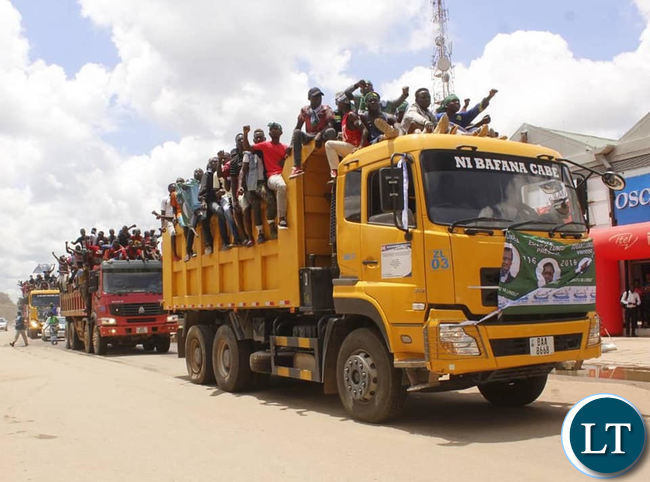
Hundreds of small-scale miners commonly known as Jerabos backed by freedom fighters and youths from the ruling Patriotic Front have marched on the streets of Mufulira asking for government to give them the mineral rich dump site called the Black Mountain.
The procession, which stretched for over five hundred meters, involved several Jerabos riding in tipper trucks and mining equipment.
The marchers went through Mufulira’s Central Business District carrying placards for their various mining cooperatives calling for the handover of the Black Mountain in the mining town.
At the Mufulira Civic Center where they gathered, Bonse Chesu Mining Union Cooperative Secretary General Gift Chibale said over 50 cooperatives are appealing to President Edgar Lungu to hand over the Black mountain to the youths.
Mr. Chibale said the slug dump will help young people create their own jobs and have viable businesses.
He added that among the cooperatives are those representing widows, former miners, Jerabos, youths and freedom fighters.
Mufulira Deputy Mayor Beatrice Kapansa and PF Copperbelt Province Youth Chairperson Don Mungulube attended the event.
All Peoples Congress Leader Nason Msoni says the merciless and ruthless expulsion of the Copperbelt university student union leaders by the PF regime stinks.
Party President Nason Msoni says the footprints are rather too apparent to be traced back to the source of the expulsion.
Mr. Msoni said in a nation with a leadership that acts on emotional turbulence and instil with the fear for regime change, this is entirely to be expected.
He said inferiority complex in any national leadership can be very destructive and shameful.
Mr. Msoni added that this is clearly illustrated by the willingness and without any sense of shame to deprive young vulnerable people of their much needed education whilst the leadership is busy putting itself forward to solicit and receive unearned university honours degrees for self gratification merely to satisfy their personal egos.
He has denounced the expulsion of students in the strongest terms and called for their immediate readmission in the university unconditionally.
Mr. Msoni warned that if the PF doesn’t change course Zambia is heading towards the same predicament as friends in Malawi.
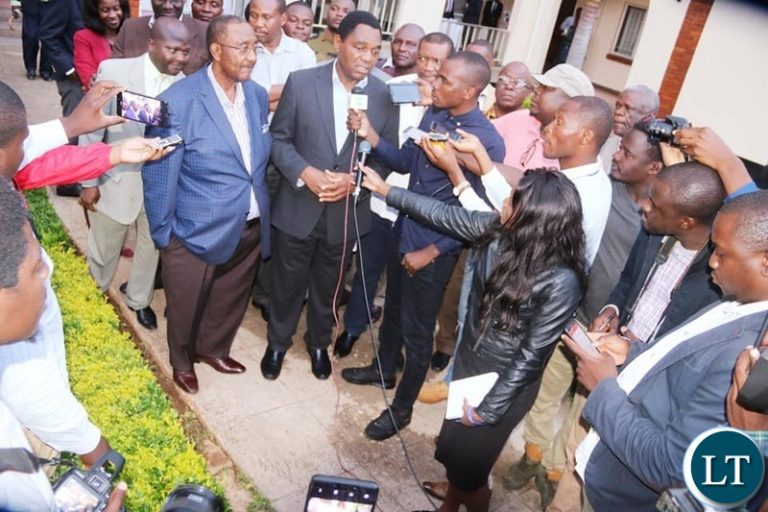
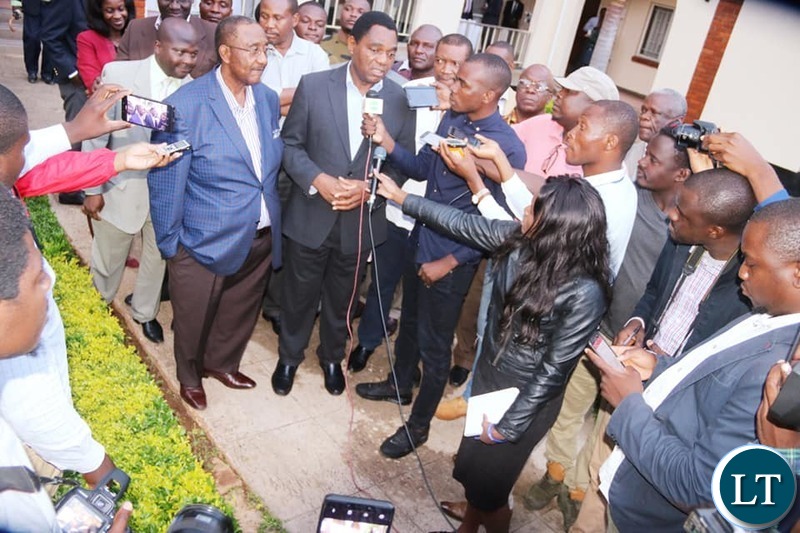
FILE: HH and GBM being Interviewed after the Dialogue Meeting
THE Constitutional Court has warned that it will throw out the petition where UPND president Hakainde Hichilema and his former running mate, Geoffrey Mwamba, want the court to declare that the Speaker of the National Assembly should have assumed powers of the President when the election petition was in court.
Justice Palan Mulonda said the matter will be dismissed if the parties in the matter will fail to comply with the orders for directions.
He said this when the matter came up for status conference in the Constitutional Court last week.
This is in a matter where Mr Hichilema and Mr Mwamba petitioned the court in August 2016 after the presidential election seeking an order directed at the Speaker of the National Assembly to assume executive powers until determination of the presidential petition.
They also wanted the court to prohibit President Edgar Lungu from performing the executive functions. The petitioners sued President Lungu and the Attorney General.
When the matter came up last week, however, lawyer representing the UPND leader, Jeffrey Chimankata, said his clients where serious about prosecution of the matter but that they wanted to amend their request in the petition.
“At the last sitting, he had indicated to the court that the petitioners are desirous of amending the petition. However, after further deliberations our instructions are that we should continue with the way things are on record as it is now a question of interpretation, stated Mr Chimankata.
“We will rely on the skeleton arguments filed on August 31 2016 save for an amendment to the prayer that was there. Otherwise, the petitioners are serious with prosecuting this matter and would like to see it concluded,” Mr Chimankata said.
Meanwhile, counsel from the Attorney General’s Chambers, Francis Mwale, said he will wait for the amendment to the petitioner’s prayer so that they could respond.
Justice Mulonda however, said he was granting the last status conference and ordered parties to file the necessary documents as agreed by July 9 this year or he would dismiss the matter for want of prosecution.
“Having heard from the petitioner that they are serious with their intention to prosecute this matter, my court will take it that these agreed upon dates will be observed, failure to which this matter will be dismissed for want of prosecution,” Justice Mulonda said.
The World Bank group has launched the solar and wind resource atlas and handed over the resource mapping measuring equipment to the Ministry of Energy, aimed at giving accurate information on the solar and wind resources in the country.
Minister of Energy Mathew Nhkuwa has disclosed that government is diversifying the national energy mix through the utilization of the abundant renewable energy resources available in the country, with a view to mitigate the effects of climate change.
Mr Nhkuwa however noted that the sector has been facing challenges in the process of diversification due to inadequate information on solar and wind resources which can be used for planning and project formulation.
He said this is why the World Bank, in collaboration with the Ministry of Energy has been conducting the resource mapping project for the past two years, starting in 2016, whose outcome is the resource atlas for wind and solar.
Speaking at a media briefing in Lusaka today, the Minister said the resource atlas mapping presented will provide variable information that will encourage developers to invest in solar and wind as a way of complementing hydro power which is vulnerable to climate change.
Mr Nhkuwa added that with the launch of the mappings it is expected that power developers will have reduced feasibility study costs as they will have power generation.
The Minister further explained that the equipment will also be used for continuous measurements of the resources as the modelling of the projects will require latest raw data.
He noted that government will ensure that equipment is managed sustainably by local institutions, who will include the University of Zambia and the Zambia Meteorological department who were selected to ensure that effective mechanisms are put in place for sound operations and maintenance.
And World Bank Group Country Manager Ina-Marlene Ruthenberg said Zambia is endowed with enormous renewable resources, including solar energy, wind and small hydro plants which have remained undeveloped due to lack of data.
Ms Ruthenberg added that lack of available resources, lack of available funding and inadequate policy provisions has negatively affected the development of potential renewable energy in the country.
She said the World Bank Energy Sector Management Assistance Programme (ESMAP) working with government initiated the assessment of solar and wind resources with an aim to develop the solar wind resource maps for Zambia, in order to provide quick and easy access to solar and wind resource data.
Under the project eight wind masts of 80 metres high and six state of art solar measuring equipment were installed across the country to collect valuable data for the resources.
The Zambian Government has sent a message of condolence to the Federal Democratic Republic Ethiopia following the killing of four senior government officials.
The armed attacks saw the assassination of among others, the Chief of Staff and the regional governor of Ahmara Region.
Zambia’s Ambassador to Ethiopia Emmanuel Mwamba says Zambia strongly condemns the attacks that occurred in Addis Ababa and Bahrda cities in which the President of the Ahmara Region and Head of the Military were killed.
He said Zambia and Africa have welcomed democratic and economic reforms being spearheaded by the government of Prime Minister Abiy Ahmed and was therefore saddened by the attacks against his government.
Mr Mwamba wished the President, Prime Minister and the people of Ethiopia strength during the difficult period.
He was speaking on Sunday at a Diplomatic briefing called by both the Prime Minister’s Office and the Ministry of Foreign Affairs on the matter in Addis Ababa.
Meanwhile, the Government of Ethiopia has assured that the attempted coup was quelled and that the perpetrators would be brought to justice.
And the security in Ethiopia has been raised and security measures such as cut in internet connections have been implemented following the armed attacks.
Government has named a retired Brigadier General who was recently pardoned and released from prison as having led the attacks against the Ahmara regional government.
This is contained in a statement released to ZANIS in Lusaka today, by First Secretary Press and Tourism at the Zambian Embassy in Ethiopia Inutu Mwanza.
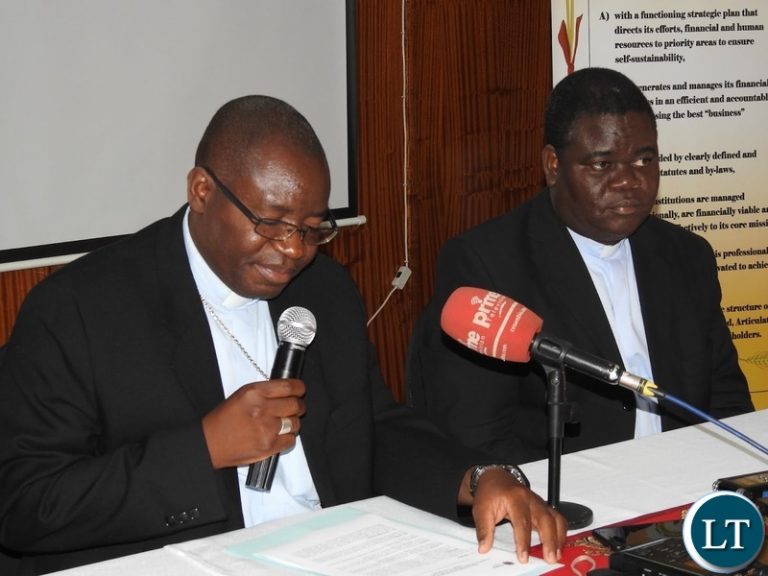
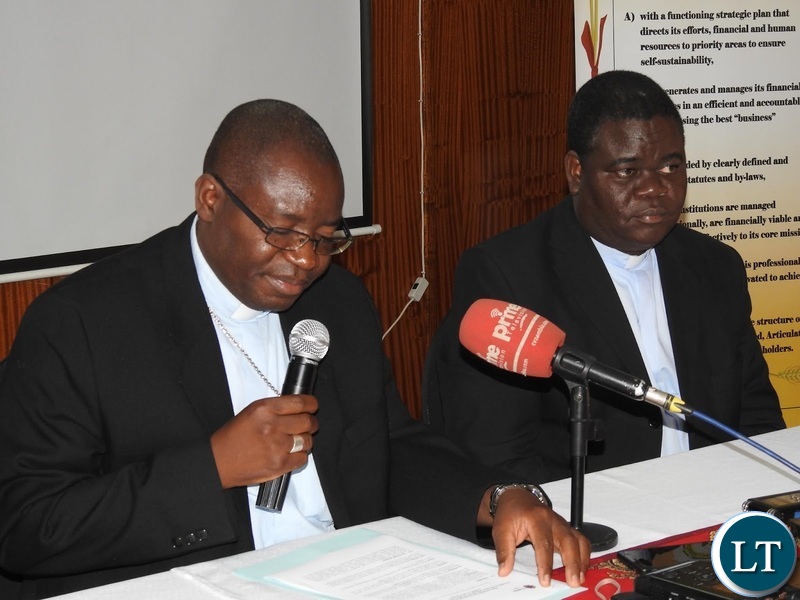
Rt. Rev. Chinyemba,OMI ( with Microphone) addressing Journalists
The Catholic Bishops in Zambia have launched a campaign to raise slightly over 9 million US dollars for relief food to be distributed in areas that were hit by drought and floods during the 2018/2019 farming season.
Making the announcement recently, Zambia Conference of Catholic Bishops (ZCCB) Bishop Director for Caritas Zambia Rt. Rev. Evans Chinyemba, OMI said that if the hunger situation is not addressed, people could soon starve to death in the affected areas. Bishop Evans Chinyemba, OMI said the hunger situation is bad and water has equally become a problem in the areas hit with drought in the southern part of the Zambia.
“To fully comprehend the hunger situation in the country, the Catholic Church through Caritas Zambia working with Diocesan partners gathered information from the affected households using community interviews, focus groups, direct observation and household field visitation in the affected areas.
Aware that the hungry people are vulnerable and easily manipulated leading to loss of dignity and having analysed the reports of the hunger situation in Southern, Central, western, Eastern, Luapula and other parts of the country, we would like to inform the nation of our concerns as well as to make an earnest appeal.”
“Listening to the Word of God inspires us to be instruments of justice, peace and love in order to spread this love to all people especially those who are currently suffering from hunger and lack of clean water,” Bishop Chinyemba said.
Bishop Chinyemba said some households did not have enough food to take them through until next year. “Southern, Western and some parts of Eastern, Central and Lusaka provinces experienced total crop failure.
This means that households in these areas did not harvest anything that would help to sustain their livelihoods up to the next agricultural season. There are 50 districts affected by this situation and households are currently already experiencing serious hunger,” he said.
“According to the vulnerability Assessment Committee (VAC) under DMMU (Disaster Management and Mitigation Unity), a total of 418,969 households were affected by the dry spell hazard. In the places visited by the Catholic Church agents, 79 per cent of the crops were affected by drought, 13 per cent by floods while four per cent were affected by both drought and floods.”
Bishop Chinyemba also shared that water supply to the people and livestock had been affected by the adverse rainfall. “Apart from crop failure, the prolonged dry spell during the last farming period has created water shortage for both people and animals. There are already reports from Gwembe that people are sharing water with animals,” he said.
“There are currently many households that have nothing to eat and are surviving on wild fruits or are getting-by without any food. This will certainly compromise the nutrition and health status of most people especially the children and if nothing is urgently done, we may begin to experience deaths from hunger.” Bishop Chinyemba said evidence of widespread food distribution to all “these people is missing.”
“In places where this is happening, the amount of food given is so little that households are failing to meet their food requirements,” he said.
“The ZCCB through Caritas Zambia in collaboration with the Catholic Relief Services (CRS), Norwegian Church Aid, and CAFOD is putting together relief effort to contribute towards the alleviation of hunger in the affected regions. This effort will target 10 per cent (42,000 households) of the total estimated number of 418,969 households currently in dire need of help and we call upon Zambians with the ability to make contributions to this noble cause.”
And appealing to Christians, Bishop Chinyemba said: “As followers of Christ, the mark of being truly His disciple is to respond to the needs of the little brothers and sisters who suffer.” “Remember that many of your brothers and sisters do not have access to clean water and lack this basic necessity. Your support no matter how little will go a long way in saving that little child in Kaoma, Pemba, and Kazungula,” he said.
Bishop Chinyemba further asked politicians to avoid taking advantage of people’s desperation, and asked the government to declare a hunger disaster.
“Government of the Republic of Zambia must consider declaring the hunger situation in some parts of the country as a disaster,” Bishop Chinyemba said.
Zesco United CEO Richard Mulenga says the door will always be open for outgoing striker Lazarus Kambole at the seven-time champions.
Kambole is leaving Zesco after six seasons with the Ndola club to join South African side Kaiser Chiefs on a three-year deal starting on July 1, 2019.
On Saturday, Kambole capped his final competitive home match with Zesco’s last goal in their 4-1 win over Zanaco in the 2019 ABSA Cup final played at Levy Mwanawasa Stadium in Ndola.
“It was a brilliant goal. We just wish him well and we wish him the best of luck where he is going,” Mulenga said.
“He has been of great service to our team and if he ever wants to come back, our door will always be open for him.”
This will be Kambole’s first foreign stint since Zesco plucked him from Konkola Blades in 2014.
The Zambia Police Service on the Copperbelt has engaged Lusaka Office to help with the re-arresting of Chifubu Member of Parliament Frank Ng’ambi for allegedly beating his wife.
Copperbelt Police Commissioner Charity Katanga says this is because Mr. Ng’ambi is out of jurisdiction.
Mr. Ng’ambi was discharged through a nolle Prosequi before the Director of Public Prosecutions (DPP) ordered for his re-arrest.
Copperbelt Police Commissioner Charity Katanga has also clarified that the prosecution entered a nolle prosequi without informing the Police.
Mrs. Katanga told ZNBC News that the instruction to re-arrest the suspect was only given after a day.
She said in a normal situation, prosecutors are supposed to inform the police before entering a Nolle if there is need to re- arrest a suspect.
Mrs. Katanga further explained that the prosecution of cases is no longer being done by the Police but by the National Prosecution Authority (NPA).
She said Police can only know if the suspect needs to be re-arrested after a nolle upon being communicated to by the prosecutor.
Mrs. Katanga said when Mr. Ng’ambi was arrested, the police refused to grant him bond looking at the seriousness of the matter.
She said the accused was only given bail by the court.
Last week the DPP issued a statement claiming that the state entered a nolle in the matter with the view to re arrest Mr. Ng’ambi.
The DPPs office wondered why the accused has not been rearrested when instruction was allegedly given.
The DPPs office explained that the reason for entering a nolle prosequi was to slap the suspect with appropriate charges that are in line with the gravity of the offence.