Saturday, June 6, 2026
25.2 C
Lusaka
Home Blog Page 905

Ploy to ban international trophy hunting at odds with Africa’s interest, a Zambian perspective

7

By Emmanuel Koro

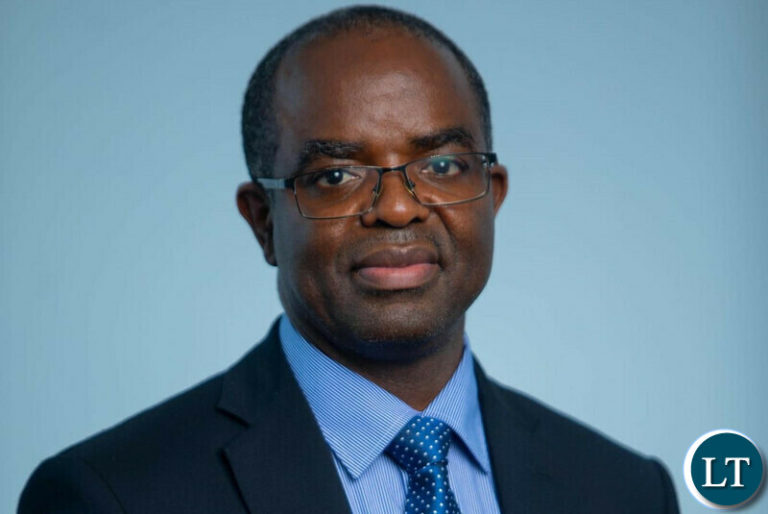
Zambia’s Green Economy and Environment Minister, Collins Nzovu has confirmed that international hunting is benefiting hunting communities and supporting wildlife and habitat conservation in his country.

Minister Nzovu’s confirmation of international hunting’s socio-economic benefits to Zambian communities as well as its support towards wildlife and habitat conservation comes at a time when the British Government is being pressurised by the anti-hunting animal rights groups there, to demonise international hunting and ban hunting trophy imports worldwide including hunting trophies of Africa’s big five.

Accordingly, Minister Nzovu has warned that any future trophy hunting import bans would take away international hunting benefits from the African hunting communities and also remove incentives for community wildlife and habitat conservation, in Zambia and Africa.

He said that Zambian hunting communities have continued to benefit from international hunting under a “50-50” hunting revenue benefit-sharing arrangement with the Zambian Government. Minister Nzovu said that the other socio-economic benefits include the “construction of schools in hunting .

“We have 50-50 share between communities (hunting communities) and the Government,” said Minister Nzovu adding that the “50-50” international hunting revenue benefit-sharing arrangement is supported by a Zambian Government “statutory instrument.”

Meanwhile, local and international observers continue to warn that “without international hunting benefits the rural communities all over Africa will see no value in wildlife and would rather collaborate with poachers to kill the continent’s big game such as rhinos, elephants, leopards, lions and buffaloes.”

“We can only encourage them (countries that want to ban international hunting) to learn from the people who are doing and have done it (international hunting),” said Minister Nzovu.

“If they (anti-international hunting countries) feel that they don’t get any key learning from it, they should learn from the people that are co-existing with wildlife (African hunting communities).”

One of Zambia’s most stunning mindset-changing hunting benefits during the 21st Century were recently experienced in the South Luangwa community that opted to accept a previously taboo culture of family planning, so that they could prevent human overpopulation that would result in them taking up wilderness land set aside for wildlife hunting and conservation.

Elsewhere in Zambia, the international hunting benefits have also enhanced the anti-poaching culture in Zambian rural communities of Kazungula District, right in the heart of the world’s richest wildlife area, the Kavango-Zambezi (KAZA) Transfrontier Conservation Area (TFCA).

In a recent interview, Mr Roy Seemani, Acting Ranger of Zambia Department of National Parks and Wildlife, in charge of Mulombedzi and Sichifulo Game Management Area (GMA), said that the local communities “have continued to show a progressive shift towards wildlife and habitat conservation, incentivised by hunting benefits.”

“Local communities’ perceptions towards wildlife are much better compared to the previous years when they used to poach wildlife because it didn’t bring benefits to them,” said Mr Seemani.

He said that the hunting companies “help create employment” in the hunting communities.

They sign contracts that make it mandatory for them to ensure they employ 30% of people from local communities, pay for wild resources monitoring, in order to evaluate the use and conservation of resources, including fire management.

The companies also pay for anti-poaching operations.

“Some of the hunting revenue is also used to support community livelihoods, including the construction of community clinics and schools,” said Mr Seemani.

Meanwhile, the Zambian hunting communities, including other southern African hunting communities have started warning that the United Nations should never hope to achieve Sustainable Development Goals (SDGs) by 2030 as long as its member countries such as the British Government continue to oppose international hunting that clearly contributes towards the achievement of SDGs through wildlife and habitat conservation and poverty alleviation also through supporting socio-economic development opportunities in African countries’ hunting communities, including employment creation for game rangers.

The southern African hunting communities also say, “It’s a violation of African people’s rights to talk about animal rights without also talking about human rights and needs.

It’s double standards and hypocritical for Western governments to speak in favour of poverty alleviation in Africa but ironically blocking such opportunity by banning the means towards achieving it — wild trade, including international hunting.”

However, there is still hope to achieve SDGs in Africa if there is no external interference on how the continent should benefit from its wild resources.

“SDGs are doable if there is political will at domestic level,” said Minister Nzovu seemingly hinting that Zambia has no control over the external factors that can fail the achievement of SDGs in Africa such as the British Government’s trophy hunting imports ban Bill.

“So, I have actually observed that in Africa we are slowly getting that political will from us the politicians and letting other people drive the economy to achieve SDGs.”

Zambia’s quiet diplomacy in its efforts to convince the Western countries and animal rights groups to stop their trophy hunting imports ban dictatorship in Africa ended when it broke its silence in May 2021.

In May 2021, the then Director of the Zambia Department of National Parks and Wildlife, Dr Chuma Simukonda questioned why Western countries lawmakers continue to pursue trophy hunting imports bans, without consulting African countries.

His question put a spotlight on the unwelcome Western dictatorship of wildlife management in Africa, including the attempts to ban international hunting.

“It is unfortunate that such efforts promoted in the name of African species lack any input from Africans and are grounded on a protectionist mentality contrary to the sustainable-use model that has proven so successful in Zambia and much of southern Africa,” said Dr Simukonda.

“Zambia’s wildlife is already stable without such ill-informed legislation (to ban international hunting). Our wildlife management system is based on science, adaptation, and community empowerment.”

About 12 months later in 2022, Minister Nzovu has repeated the call not to ban trophy hunting imports from his country and the African continent as this would not only harm wildlife and habitat conservation but also negatively impact on the socio-economic wellbeing of hunting communities.

“We are all sovereign states,” said Minister Nzovu.

“So, it all depends on what you want to do with your particular resource.

So, for those particular countries (anti-international hunting countries) we would encourage them to understand that the beneficiation that we are getting are also going to the communities, wildlife and habitat conservation.”

He said the world should learn about international hunting benefits from the communities that make wildlife and habitat conservation sacrifices.

“These communities are the ones who let go of their pieces of land so that we create space for protected areas, be it national parks, forestry and game management areas,” said Minister Nzovu.

– Emmanuel is a Johannesburg-based international award-winning environmental journalist who writes independently on environment and development issues in Africa.

ZRA beats mid year target by K2.1 billion

7

The Zambia Revenue Authority (ZRA) has recorded an above-target revenue performance in the first half of the year 2022.

This was after the Authority collected a net tax outturn of K48, 307.9 million against the period target of K46, 203.9 million, thereby registering a surplus of K2, 104.0 million or 4.6 percent.

ZRA Commissioner General Dingani Banda says cumulatively, the Authority collected K56, 407.9 million in gross taxes during the first half of 2022, while the refunds stood at K8, 100.0 million.

Mr. Banda says the recorded surplus was largely attributed to the strong performance of direct taxes which was driven by sustained high copper prices on the global market during the period under review.

During the second quarter of 2022, the Authority also surpassed the revenue target by collecting K29, 956.9 million in gross taxes and refunded K4, 050.0 million.

The net collections thus stood at K25, 906.9 million against the quarter target of K25, 146.3 million, thereby recording a surplus of K760.6 million or 3.0 percent.

“Gross collections during the second quarter of 2022 increased by 10.6 percent in nominal terms when compared to the corresponding quarter in 2021, while net collections in the first half of 2022 increased by 24.2 percent relative to the same period in 2021. The total refunds in first half of 2022 at K8,100.0 million increased by 57.4 percent compared to K5,146.7 million refunded during the corresponding period in 2021”, Mr. Banda said.

In terms of industry performance, the top three contributors (accounting for 63.3%) to gross revenue collections during the first half of 2022 were Mining and Quarrying, Wholesale and retail trade and Manufacturing sectors, which accounted for 43.0 percent, 11.8 percent and 8.5 percent, respectively, of the total gross collections.

The Authority has also issued the Executive Tax Bulletin for the second quarter of 2022 and can be accessed on the ZRA website.

The excellent revenue performance has also been enhanced by sustained implementation of key strategies as enshrined in ZRA’s Corporate Plan.

Some of the strategies include extensive use of data and intelligence to unearth unpaid taxes, use of technology to simplify tax processes, taxpayer engagements and education, customer support programmes; which have led to improved voluntary compliance and tax base expansion which is aimed at on-boarding taxpayers previously not paying taxes.

Other strategies include enhanced active surveillance and enforcement operations which have been reinforced by collaboration with other government agencies in the fight against economic crimes such as smuggling and other forms of tax evasion.

The improved staff productivity and high-performance culture has also enhanced revenue collection.

This follows the continuous implementation of a robust internal performance management culture by the Authority.

The Commissioner General has urged ZRA staff to continue improving performance in all aspects while meeting the expectations of all our stakeholders as stipulated in the 2022-2024 Corporate Strategic Plan.

“Once again, I salute you all for your consistent dedication to duty which is underscored by this favourable revenue outturn amidst external challenges such as rising oil prices due to the Russia-Ukraine conflict and the continued subliminal effects of the Covid-19 pandemic”, Mr. Banda said.

“Management, through the Governing Board, is committed to providing a conducive working environment and progressively addressing all matters affecting staff welfare. Finally, let us remember to always live the ZRA core values of Taxpayer focus, Integrity, Professionalism, Innovation and Networking”, Mr. Banda added.

KK 11 Icon Katowando Questions Players Passion For Football

3

Former KK 11 and Nkana goalkeeper Johnstone Katowando has told the current crop of players to take football seriously.

Katowando, who played for Zambia between 1976 and 1980, said players should be more dedicated to the game.

He observed that some players nowadays lack the zeal to play the game.

“In the past the boys were dedicated to just playing the game but these days players have combined football and money. They have put money first,” Katowando said from his base in Kitwe.

Katowando 69 was part of the Zambia squad for the Montreal 1976 Olympic Games in Canada.

“Many Zambian players are going to play outside the country but are coming back early without achieving anything. Players are lacking that zeal to play with dedication. If they work hard, current players can perform wonders,” he said.

Katowando made his name at Rhokana United now called Nkana Football Club around 1972 before joining Lusaka’s Red Arrows in 1975.

Mujembe Quits Kitwe United

0

Coach Lewingtone Mujembe has ditched Kitwe United to join FAZ Super Division side Chambishi as first assistant coach.

Mujembe joined Kitwe United, a National Division One side, as head coach last January.

Chambishi have since unveiled Mujembe as first assistant coach ahead of the 2022/2023 FAZ Super Division season.

The Konkola Blades legend has joined the Chambishi bench headed by Simonda Kaunda.

Ernest Ngosa is the second assistant coach at Chambishi.

Club spokesperson Chali Katongo said Chambishi is confident the combination of Simonda and Mujembe will bring glory to the club.

“The Executive Committee of Chambishi Football Club wishes to inform the football family on the appointment of Mr Mujembe as 1st Assistant Coach. Mr Kaunda Simonda will continue as Head Coach,” Katongo said in a media statement.

“Management is confident that the combination of the two will bring glory to Chambishi Football,” he added.

Chambishi survived relegation after finishing 14th in the Super Division on 38 points in 34 matches.

Italy assures support to Zambia to secure an IMF deal

5

Italian President Sergio Mattarella has reaffirmed his country’s commitment to support Zambia reach an understanding with the International Monetary Fund (IMF) on its debt restructuring programme.

Mr Mattarella said his country is ready to help Zambia in its economic recovery trajectory.

Speaking when he paid a courtesy call on President Hichilema at State house today, Mr Mattarella said this is one way of strengthening bilateral ties between the two countries.

“Italy stands ready to help Zambia in many sectors of the economy such as Mining, Agriculture, health and education among others. Zambia is a beacon of peace and a promoter of democratic tenets,” he said.

He explained that Italy is committed to further strengthen ties with Zambia by setting up businesses and infrastructure development among others across the country.

Mr Mattarella also praised Zambia for its resolve to fight corruption saying the vice retards economic development.

And President Hakainde Hichilema hailed Italy for the huge contributions it renders to Zambia in all sectors of the economy such as energy, Agriculture among others.

Mr Hichilema noted that the cooperation between the two countries spans many years ago when successful leaders of Italy and Zambia initiated warm relationship.

The President further called on Italy to support Zambia in its journey to access the IMF bailout which is expected to cushion the country’s challenges in many sectors of the economy.

“Indeed Zambia is grateful for Italy’s contributions and support in all the sectors of the economy especially in energy, education, agriculture among others,” he said.

Mr Hichilema added that Zambia is endowed with mineral resources which needs value addition, stating that Italy can help in that area in a bid to transform the country.

He further assured Italy of Zambia’s continuous upholding of democratic tenets, peace and stability to foster social and economic development as democracy is the hallmark of development.

The President commended his Italian counterpart for visiting Zambia as the move will spur deeper mutual understanding between the two countries.

The Italian President who is accompanied by First Lady Laura Mattarella arrived in the country yesterday.

Ex Post Master General Chanda, two others jailed for two years for unlawful diversion of over K300 million

29

Former Post Master General MacPherson Chanda and two others have been sentenced to two years imprisonment for 13 counts of theft by public servant by the Ndola Magistrate Court.

Chanda, Former Finance Director Best Mwaiche and Isaac Kamwimba were sentenced today by a Ndola Magistrate Court. The court has given the three an option of a fine amounting to K350 million.

Chanda and the two others have been found guilty in the 13 counts of theft by public servants involving over K300 million. The three unlawfully diverted social cash transfer (SCT) funds amounting to K335, 108,834 without authority.

The case was before the Economic and Financial Crimes Court Magistrate Kaunda Sakwanda.

In April Mr.Chanda and two others were found with a case to answer in all the 13 counts of theft by public servant involving over K300 million. When the case came before the Fast Track Economic and Financial Crimes Court in Ndola, magistrate Kaunda Sakwanda said after hearing the prosecution’s witnesses, she was satisfied that a prima face case had been established against the accused persons.

“I, therefore, find the accused persons with a case to answer. Having said this, I put the accused persons herein on their defence for the offence of theft by public servant in all 13 counts,” she ruled.

Last year, the Drug Enforcement Commission and the Anti-Corruption Commission (ACC) arrested Chanda and two directors for corrupt practices involving over K300,000,000.

The trio, in their capacities as Postmaster General, Director of Finance and Director of Operations, respectively, were said to have unlawfully diverted social cash transfer funds amounting to K335,108,834.00 without lawful authority.

In count one, it is alleged that between December 1, 2017 and December 31, 2021, Mcpherson Chanda, Best Mwaichi and Isaac Kamwimba jointly and whilst acting together with other persons unknown and being employed in the public service, namely as PostMaster General, Director Finance and Director operations, respectively, for the Zambia Postal Services, stole K 50,000,000, property belonging to the Government of Zambia.

In count two, it is alleged that Chanda and Kamwimba between August 1 and December 1, 2018 stole K21,945,256, property belonging to the Government of Zambia.

In count three, it is alleged that Chanda and Mwaichi between September 1 and October 1, 2017, stole K 27,363,578, property belonging to the Government of Zambia.

In counts four and five, Chanda and Mwaichi are alleged to have between March 1 and December 1, 2018, stolen K 5,500,000 and K20,000,000, property belonging to the Government of Zambia.

In count six, the two are also alleged to have stolen K16,000,000 between September 1 and December 1, 2017 and K50,000,000 between January 1, 2017 and December 1, 2018.

Other amounts Chanda and Mwaichi are alleged to have stolen include; K50,000,000 between January 1 and December 1, 2018, K25,000,000 between October 1 and December 1, 2017, K6,000,000 between January 1 and December 1, 2018, K24,300,000 between October 1 and December 1, 2017, K25,000,000 between October 9 and December 1, 2017 and K14,000,000 between October 25 and December 1, 2017.

Apathy hit continuous voter registration in Kabwe

1

Apathy has characterized the continuous voter registration in Central Province.

Kabwe Municipal Council Assistant Public Relations Manager, Nancy Chenga, says the public response has been poor and has urged eligible members of the public to take advantage of the registration centre domiciled at the Civic Centre and get registered.

Ms. Chenga, said in Kabwe that the continuous voter registration is an opportunity for all categories of eligible voters to get the voters’ card.

“The Electoral Commission of Zambia (ECZ) has launched the continuous voter registration in all the ten provincial centers to ensure an accurate register that captures all eligible Zambians that have attained 18 years and above,” Ms. Chenga said.

She has advised the members of the public to use the continuous voter registration to replace defaced and lost voters’ cards as well as to surrender voters’ cards of the deceased persons.

“During the continuous voters registration we are replacing defaced and lost voters’ cards, and collecting voters’ cards for deceased persons in order to remove them from the register and ensure accurate numbers,” she said.

She has urged people who could have also relocated to new places to take this opportunity to go to the registration centre and change the polling station.

“We have given an opportunity to people who could have shifted from different residential places or polling stations to change their polling stations to where they have relocated to so that they don’t have challenges when it comes to voting,” she stated.

The Electoral Commission of Zambia (ECZ) on 1st June 2022 launched the continuous voters’ registration in ten provincial centers and will progressively move to other centers, a paradigm shift from the previous occasional voter registration programme.

Meanwhile, Kabwe District Voter Education Officer (DVEO), Lityness Mkandawire, has appealed to the people of Kabwe who are eligible to visit the registration centre and register as voters.

Ms. Mkandawire says members of the general public are free to access the centre every day from Monday to Friday, adding that people should not wait for 2026 to have the voters’ card.

She has advised those that have lost their voters’ card to get a police report and together with the National Registration Card (NRC) go to the centre and get a replacement.

“Those that have lost their voters’ cards, they should go to the nearest police station and get a police report. The requirement for a lost card is a police report and an NRC in order to have a replacement,” Ms. Mkandawire clarified.

The church urged to form cooperatives to access CDF funds

Muchinga Province Deputy Permanent Secretary (DPS), Mathews Chilekwa has urged the Seventh Day Adventist (SDA ) Men’s Organisation to form cooperatives in order for them to access funds from the Community Development Funds (CDF).

Mr Chilekwa said this during the Adventist Men’s Organization three -day entrepreneurship training held in Nakonde District.

The training drew participants from all the districts of Muchinga and Northern Provinces apart from Chilubi.

Rev. Chilekwa said that the government has put in place several programmes to empower the people of Zambia.

He challenged the Adventist men to come up with good business proposals so that they can also access the CDF.

Rev. Chilekwa said that the church should also be involved in the development of the nation saying Government alone cannot do everything.

The Deputy Permanent Secretary also thanked the organisers of the training and encouraged them to continue with the same spirit.

He said that the nation can only be developed when people become self-reliant by having or creating their own jobs.

“We all need to be involved in the development of our mother Zambia by engaging ourselves in economic activities, ” said Reverend Chilekwa.

Speaking at the same event, North Zambia Field president, Samuel Sinyangwe said that the purpose of the training was to equip the church members with knowledge of entrepreneurship.

Pastor Sinyangwe said that the church should not just wait for hand outs but should start creating wealth by getting involved in activities which will generate income.

He said instead of waiting for the government alone to employ people, the church should learn how to create jobs so that it’s members are empowered.

“Let’s be active and engage ourselves in business activities that will contribute to the economic development of the country, ” said pastor Sinyangwe.

And one of the facilitators of the training Joseph Mushalika said that it is high time Zambians ultilised potential which they have so that tangible results are seen in the community

He said that Zambia has alot of natural resources capable of improving the livelihoods of people if properly enhanced and used.

“Let’s use our natural resources to improve our lives,” said Mr. Mushalika.

Mweemba Michelo one of the participants disclosed that he has acquired alot of knowledge which shall make him a useful person in the community.

“I have learnt a lot of things from training, ” said Michelo.

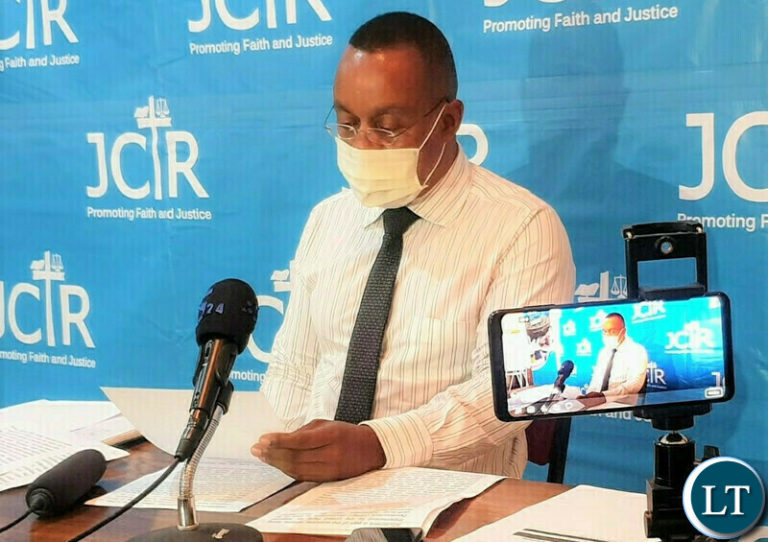
People want to see less punitive taxes in the next National Budget-JCTR

4

The Jesuit Centre for Theological Reflection (JCTR) has called for a pro-poor 2023 National Budget.

The Ministry of Finance and National Planning recently called for proposals as it formulates the 2023 National Budget which is expected to be unveiled in the last quarter of this year.

JCTR Executive Director Fr. Alex Muyebe, S.J. said People want to see less punitive taxes in the next National Budget.

Fr. Muyebe said no country can achieve sustained economic growth for national development without effectively addressing wide-spread poverty in its population.

The Catholic Priest said Zambia today has become so accustomed to coexisting peacefully with poverty.

“After an estimated 1.5 percentage point increase in the international poverty rate between 2019 and 2020, the poverty headcount in Zambia is projected to have remained high, at about 60% in 2021 (the World Bank Macro Poverty Outlook, April 2022). The rise in poverty has been largely driven by falling incomes in urban areas, especially among those relying on employment income from the informal sector. A World Bank Household Monitoring phone survey found that 4 in 5 households reported a drop in income from nonfarm business, and that 1 in 3 reported a reduction or disappearance of wages due to the pandemic (ibid). A recent Socio-economic Impact Assessment conducted by the National Statistical Office found that 9 in 10 households have experienced spikes in the price of food, and that 64% of these had to reduce food consumption as a result (ibid),” Fr. Muyebe said.

“The hard fact is that the number of people living in poverty in Zambia remains very high. Poverty has always been one of the major barriers to human development in Zambia since independence in 1964. No country can achieve sustained economic growth for national development without effectively addressing wide-spread poverty in its population. Unfortunately, in Zambia today we have become so accustomed to coexisting peacefully with poverty that we no longer get alarmed when we hear of stressful stories of our brothers and sisters in poor households around the country who are struggling to barely survive due to the rising cost of living. Something is not adding up. Even if the speed at which prices are increasing is on the slowdown, the fact is that commodity prices are very high and are likely to remain that way for some time given the ever increasing fuel pump prices,” he noted.

Fr. Muyebe continued:”There are several cases out there of guards, maids and farm workers earning far less than K1, 000 per month. This is not meant to be a finger pointing exercise but rather an attempt to rally support from all stakeholders (all of us) across the country to wake up to this very sad reality and together to begin to seriously address poverty in Zambia. Poverty is not about statistics but it is about the lives of our brothers and sisters in our society who are being deprived of decent livelihood and the minimum level of human dignity. We note that Bernard’s household like several others across the country can hardly afford fruits in their food basket. Seasonal food items like fruits accounted for a negligible reduction in the JCTR’s Basic Needs and Nutrition basket in April and May 2022.”

Fr. Muyebe said the government should demonstrate that it is a listening regime by formulating a pro-poor 2023 national budget.

“In fact, the social and economic reality in the country is getting worse. As we continue to interact with people living in challenging circumstances, it is very clear that the least the government can do as it puts together the 2023 national budget is to demonstrate that it is a listening government, notwithstanding the challenges of prolonged debt negotiations, by putting in place some measures to address the majority’s demand for affordable food and shelter. People want not only jobs but also decent incomes and a living wage coupled with less punitive taxes. These demands are not new. The party that is now in government reverberated the people’s aspirations in some of its election promises in the run up to the elections last year. The people of Zambia are keenly watching to see if the new administration is going to fulfill a great deal of its election promises by the time of its first anniversary in government next month,” Fr. Muyebe concluded.

Liquidity challenge in the economy is driving reduction in inflation-Hambayi

1

Economist Trevor Hambayi says reduction in inflation rate is due to liquidity challenge in the economy.

Mr. Hambayi said the absence of spending is driving the current decreasing inflation.

He said there is nothing uneconomical with having a decreasing inflation with increasing prices.

“Economic definition of inflation is the rate at which prices increase. All it’s saying is that the rate at which the prices are increasing has reduced from 23% to 9.7% but still an increase in prices,” Mr. Hambayi said.

“The one key question should be what is driving the decrease in inflation. They are a number of factors that drive inflation but the single largest factor driving our current decrease in inflation is the liquidity challenge in the economy,” he said.

He said Government payments have always been key ingredients in driving our economy and the suspension of payment of arrears and the continued govt domestic borrowing of over K5 billion monthly from the domestic capital market has constrained availability of cash in the economy.

“This absence of spending is driving our current decreasing inflation. A sound and solid economy needs an underlying asset to sustain macro stability and thus important that we build a solid private sector led growth that will reduce inflation on the strength of productivity,” he said.

KCM starts payments of outstanding debt to small suppliers and contractors

8

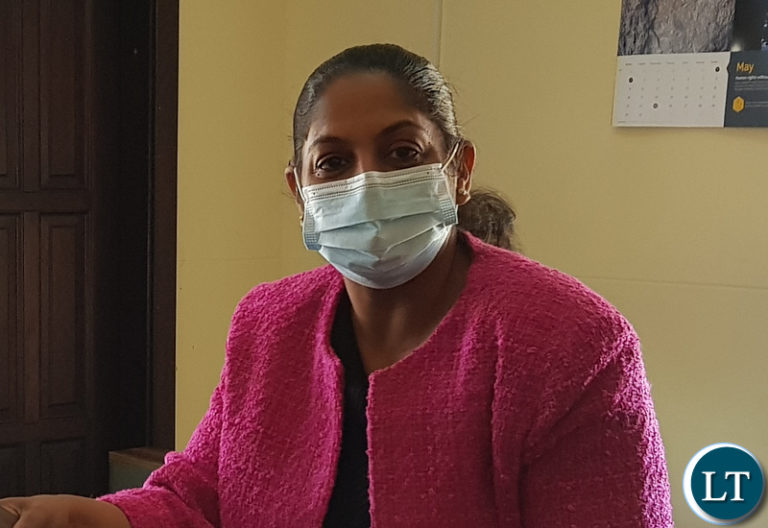
Konkola Copper Mines Plc (KCM) Provisional Liquidator Celine Nair has announced that the Company has set aside two million United States dollars ($2 million) to dismantle outstanding historical debt to small and medium suppliers and contractors in a bid to reduce liabilities and aid the growth of businesses.
 
In a statement released to the media by Ms Nair, who is the acting Administrator General and Official Receiver of Zambia, said she had taken a decision to pay outstanding debt, following consultations with KCM Management, in order to support small vendors and suppliers, some of whom had been waiting for their payments for some time.
 
“The Company is fully aware that it has been difficult for our business partners to operate smoothly and grow their enterprises because part of their money has been tied up and was only expected to be paid off at the end of the liquidation process,” Ms Nair said. “But a call was made to pay now in order to create some relief to the KCM business partners.”
 
KCM has allocated about $488,675 to pay off 103 vendors with balances below $10,000, while slightly over $1.5 million was set aside for 190 vendors who have been owed amounts in excess of $10,000, under a new system seeking to ensure equitable treatment of all vendors regardless of their type of business with the Company.
 
The payments to the business partners started on Thursday, 30th June 2022 and will continue through this week until all those listed on the schedule are paid off.
 
Previously KCM has focused much on payments to major contractors who assist in keeping operations afloat during the liquidation period, resulting in other suppliers and contractors going for long periods without receiving payment, but that has changed following measures introduced since Ms Nair took over the office of KCM Provisional Liquidator about two months ago.
 
“It is our sincere hope that the newly devised system will ensure all vendors regardless of their size are treated fairly as we support growth of KCM, the mining sector and other related industry and the national economy,” She said.
 

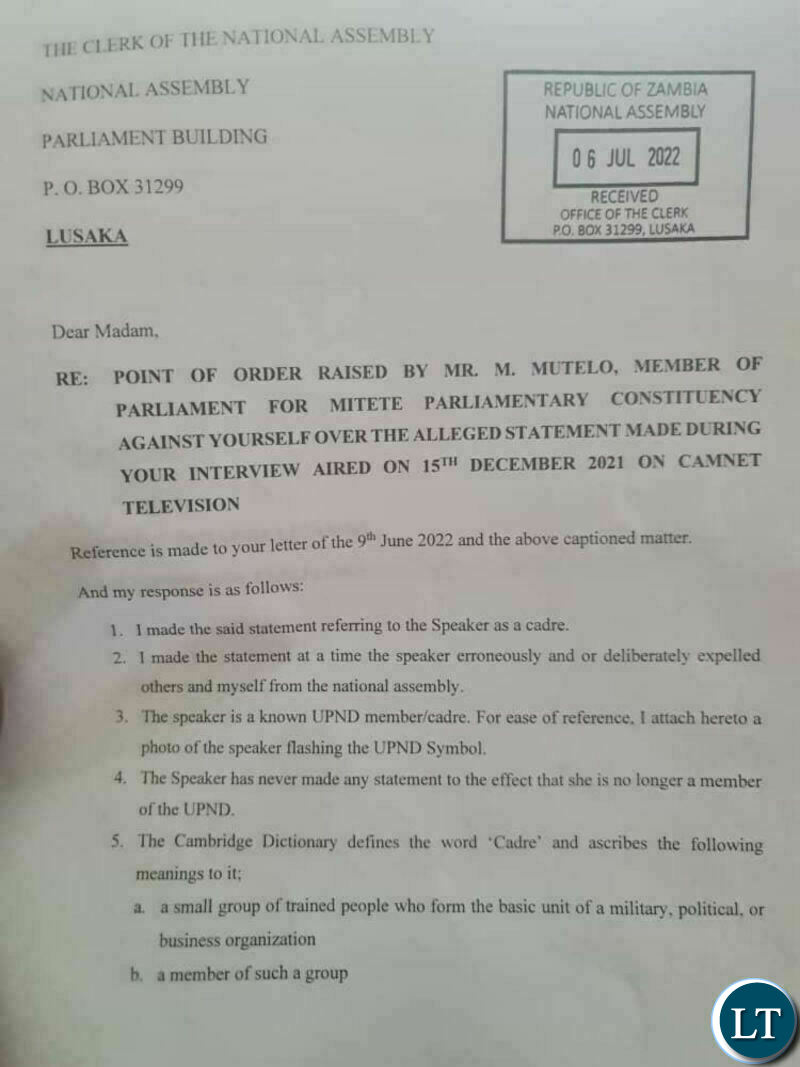
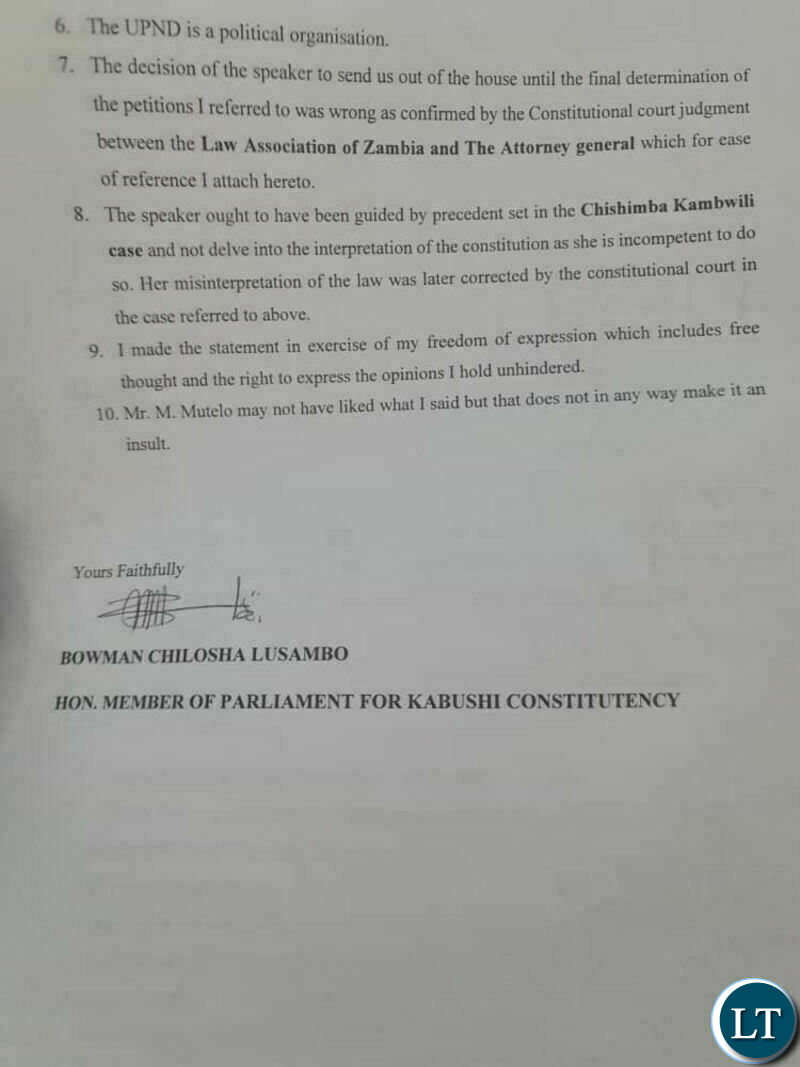
Speaker Nelly Mutti is a UPND cadre, insists Bowman Lusambo

Kabushi Member of Parliament Bowman Lusambo has insisted that Speaker Nellie Mutti is a UPND cadre.

This is contained in a letter dated July 6th 2022 to Mrs Mutti in response to a Point of Order raised by Mitete Member of Parliament Misheck Mutelo over an alleged statement Mr. Lusambo made during an interview with Camnet TV last December in which Mr. Lusambo described Mrs Mutti as a cadre.

The Camnet TV interview was after Mrs Mutti erroneously made a ruling expelling Mr. Lusambo and other PF Members of Parliament from the House.

In the letter obtained from National Assembly, Mr. Lusambo said he doesn’t refute making a statement referring to Mrs Mutti as a cadre.

The Kabushi MP insisted that he made the statement in exercise of his constitutional right to free expression.

He said the Speaker is a known member of the UPND/cadre and attached a picture of the speaker flashing the UPND party symbol.

Mr. Lusambo said the Speaker has never made any statement to the effect that she is no longer a member of the UPND.

“The Cambridge University defines the word “Cadre” as ascribes the following meaning to it, (a) a small group of trained people who form a basic unit of a military, political of business organisation. (b) a member of such a group,” the letter read.

Mr. Lusambo stressed that the UPND is a political organisation and that the decision by Mrs Mutti to send him and other PF MPs out of the House before the final determination of their court petitions was wrong as confirmed by the Constitutional Court.

“Mr. Mutelo may not have liked what I said but that does not in any way make it an insult,” he said.

AU Summit to enhance trade in Africa

7

The Centre for Policy Trade and Development (CTPD) has urged African countries to devise mechanisms on how they will address the looming food crisis in the region.

CTPD Executive Director, Isaac Mwaipopo has observed that with continued negative effects of climate change affecting most countries coupled with the effects of the Russia and Ukraine war, there is need for the member states to intensify their food production efforts.

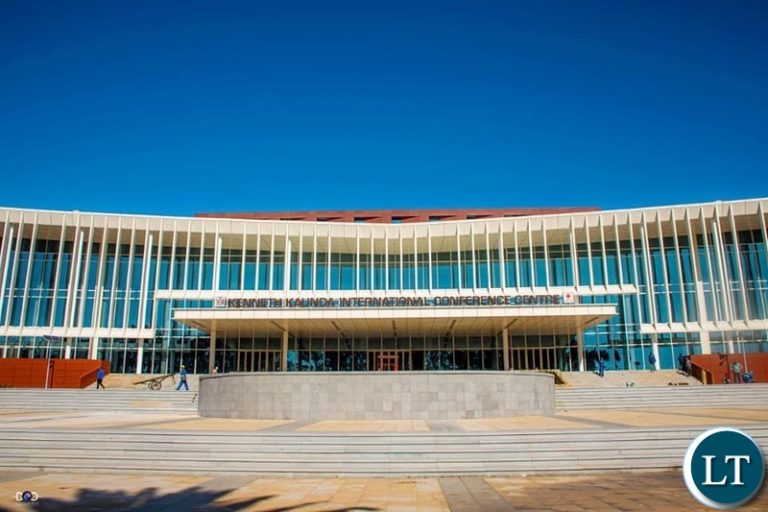
Mr. Mwaipopo told ZANIS in an interview in Lusaka that as Zambia hosts the 4th Mid-Year Coordination Meeting of the African Union from 14 to 17 July 2022, African countries should use the meeting to find measures of improving its farming production capacity.

He explained that with the theme well centered on food production and nutrition, there is a need for countries to grow enough food for themselves.

“It is good that the summit theme highlights what is happening in the agriculture sector not only in Zambia. Many African countries are grappling with a number of challenges some coming from the negative effects of climate change which is impacting on their ability to grow enough food especially nutritious food,” he said.

He regretted that statistics indicate that many African countries will by 2023 face critical food shortages arising from increased production costs such as inputs.

Mr. Mwaipopo said this is why as African leaders meet for the summit in Zambia, they should discuss how the region should consider investing more in industrialization and start local manufacturing of vital farming requirements such as fertilizer.

He explained that it is the dependency of inputs like fertilizer from Western countries that has resulted in increased production costs of agriculture, hence the need to set up manufacturing plants within Africa will make it easy for the continent to produce adequate food.

“It is sad to note that some statistics indicate that SADC and a number of other countries are likely to face food shortages, this is not only peculiar to Africa, but the whole world due to the Russia-Ukraine war, therefore we are confident that the African leaders will during the summit have conversations on how industries can be set up within the continent which will make it easy to produce vital inputs such as fertilizer that is needed for our food production, “he added.

Meanwhile, Mr. Mwaipopo also expressed optimism that Zambia is expected to significantly benefit from hosting the 4th Mid-Year Coordination Meeting of the AU.

He explained that the meeting will present the country with the opportunity to market its potential to host international events and its prospects in various sectors of the economy.

Mr. Mwaipopo stated that this is an opportunity for Zambia and other countries to engage each other on a number of trade agreements that have been signed in order to strengthen their relations especially in the movement of goods and services.

He further appealed to African countries to step up their efforts and expedite the modalities on different trade agreements and ensure there is competitive goods and services that can be traded within the continent through expanded Free Trade Agreement (FTA) of the African Continental Free Trade Area (AfCFTA).

And the Cross Border Traders Association of Zambia (CBTA), has described the hosting of the 4th Mid-Year Coordination Meeting of the AU as a milestone to the country’s trade and business community.

Association Chairperson, Goodson Mbewe said this is because the meeting will come with increased demand for local and international goods and services.

Mr. Mbewe noted that as an Association, the members are already positioning themselves to accrue the benefits that will come with the country hosting high profile dignitaries.

“As an Association we see a lot of benefits coming with the country hosting this meeting, we just hope that issues that impede the effective facilitation of trade will be tabled, we need to speak with one voice as Africa, the leaders should iron out those Non-Tariff Barriers and replace them with policies that we will ensure that Africa produces commodities that can be sold in any country without challenges,” he said.

Zambia is scheduled to host the 41st Ordinary Session of the Executive Council of the African Union and the 4th Mid-Year Coordination Meeting of the AU and the Regional Economic Communities (RECS) from July 14 to 17, in Lusaka under the theme “Strengthening Resilience in Nutrition and Food Security on the African Continent:

About 13 Heads of State and over 800 delegates are expected to attend the AU mid-year summit in Lusaka, Zambia.

Financing institutions are withholding this country’s developmental activities – Mbambiko

7

THE Kitwe Chamber of Commerce Trade and Industry charges that calls for value addition to local products will remain unattainable as long as lending institutions refuse to
adjust their financing conditions.

Chamber president Emmanuel Mbambiko says because their high cost of borrowing, commercial banks are making it difficult for entrepreneurs to go into value addition

Mr Mambiko in an interview, Wednesday, noted that although the government has already provided a conducive environment
for doing business, the cost of financing from commercial banks however is unbearable.

”The financing institutions are the ones withholding the developmental activities in this country, they are too rigid and expensive, I don’t Know if it’s government borrowing that is making them\

remain ridiculously high to make government withdraw from that borrowing window, but they need to come on board otherwise they are not helping the country,” He said

He further accused commercial banks of having formed a cartel to deprive local entrepreneurs of funding by exaggerating their lending rates
which are pegged within on the same range for all banks.

Mr. Mbambiko noted that it was unfortunate that government cannot force banks to relax its lending rates in a liberated economy that
Zambia has adopted.

He expressed hope that the Central Bank will rise to the occasion and advise the commercial banks to relax their lending.

conditions to boost economic activities.

He however commended President Hakainde Hichilema for emphasizing on the need for Zambian entrepreneurs to add value to their product during the just ended
Trade Fair in Ndola.

Value addition to locally produced products will enable entrepreneurs and the country at large to increase the economic value of the local products.

During the just ended Trade Fair in Ndola, which was held under the theme: ‘Promoting Value Addition for Sustainable Growth’, President Hakainde Hichilema stressed on the need to add value to the local
products through processing of finished products.

The Mukula tree logs as one of the products that , President Hakainde cited , can be processed instead of exporting it raw when it can be processed and used to make good quality desks locally.

Hasten implementation of the JPC between Malawi and Zambia – Mulyata

The government has called for the revival of the Joint Permanent Commission (JPC) between Malawi and Zambia for the quick implementation of bilateral agreements between the two neighbouring countries.

Lusaka Province Minister Sheal Mulyata has however bemoaned that the framework of cooperation between the two countries under the JPC was slowed down by the COVID-19 pandemic.

Speaking during the 58th commemoration of Malawi National day, Mrs Mulyata said the JPC which was last held in 2017 presented a good opportunity for the two countries to cooperate in various sectors including agriculture, tourism and trade, among others.

The Lusaka Province Minister maintained that the expeditious implementation of bilateral agreements is dependent on the JPC of the two countries,

“Allow me to take this opportunity to call upon our two countries to revive the JPC in order to review and speedily implement our bilateral agreements as well as to incorporate new developments of key areas of mutual interests,” Mrs Mulyata said.

And Malawi High Commissioner to Zambia, Margaret Kamoto said her country and Zambia remain determined to enhance bilateral relations evidenced by President Hakainde Hichilema and his counterpart Lazarus Chakwera’s high-level exchange visits.

Speaking during the same occasion, Ms Kamoto also called for increased trade balance and investment activities between the two countries.

The Malawian Envoy further urged the Zambian business community to utilise the friendly Malawi business environment.

“I wish to call on Zambian investors as well as foreign investors present here in Zambia to take full advantage of Malawi’s peaceful and business-friendly environment to invest in Malawi’s tourism, mining as well agriculture sectors,” Ms Kamoto said.