Sunday, June 7, 2026
17.3 C
Lusaka
Home Blog Page 1131

There is need to invest in skills training and development as part of the transformation agenda-Mutati

12

Minister of Science and Technology Felix Mutati says the government is committed to transforming the economy through the promotion of skills training and development.

Mr Mutati notes that there is need to invest in skills training and development, as part of the transformational agenda.

Speaking after touring the Lusaka Business Training Institute and the Thorn Park Trades Training Centre today, the Minister stated that skills development will contribute to overall job creation and national development.

He explained that skills development is very critical in the development of any country and hence the need for it to be promoted.

Mr Mutati commended the efforts put in by the two training schools, in offloading trained personnel that are equal to the task.

“Let us have people that are trained and certified to do the work out there, rather than people that are not qualified. Only then will the work be done well.

As we implement the 2022 budget which has a critical component of CDF and empowerment, the intention of the government is that we empower youths that are already invested in skills”, he added.

The Minister urged the youths, to impart the skills to others and form cooperatives in order to benefit from the government’s programmes.

He also encouraged them to think as entrepreneurs as they graduate in order to manage their own businesses and employ other people.

Speaking at the same event, Lusaka Business Training Institute Head of Engineering Bizeck Daka commended the government for their support in providing quality skills training at the school.

He said among the support received include new equipment that has enabled them offer Diploma programmes in Electrical and Automotive Engineering.

Mr Daka explained that the school has received overwhelming demand in skills training at all levels of training.

He has since encouraged the youths to equip themselves with the necessary skills in order to contribute to national development.

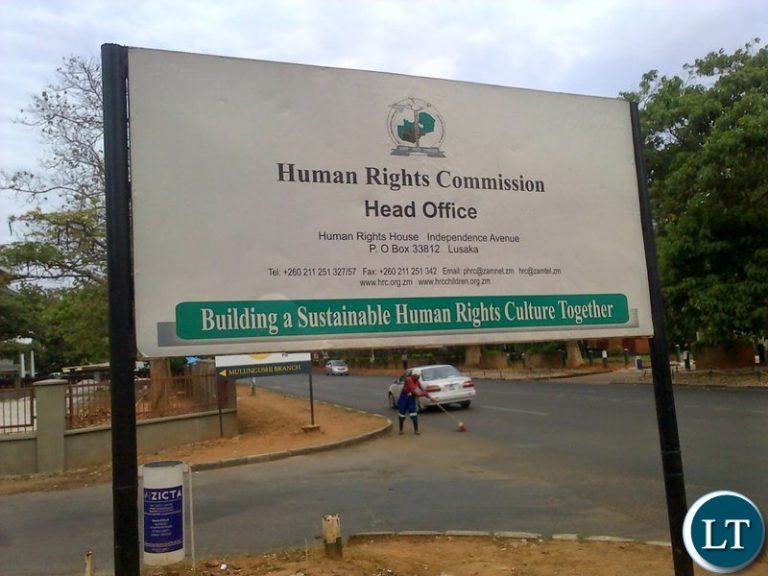
Human Rights Commission is engaging stakeholders to support the abolition of the death penalty in Zambia

2

The Human Rights Commission (HRC) says there is need to involve various stakeholders on the issues of abolishing the death penalty in Zambia.

Human Rights Commission Principle Information Officer Simon Mulumbi said stakeholders play a very important role in issues that concern the wellbeing of the people.

Mr. Mulumbi said this during a one-day consultative meeting on death penalty whose objective is to raise awareness about the fundamental right to life and explore the opportunities for collaborative efforts towards abolishing the death penalty in the country.

Mr. Mulumbi added that the commission recognises various organisations as key stakeholders in the promotion and protection of the inherent right to life.

“Death penalty is a reality which has affected many people and has impact on wide range of human rights especially the vulnerable in the society,” he said.

He added that the commission has over the years been engaging stakeholders with a view of getting support from the said stakeholders towards the abolition of the death penalty in the country.

Mr. Mulumbi further said the commission understands that death penalty constitutes a violation of one of the basic human right which is the right to life.

He further said the commission is currently in Chinsali to consult stakeholders on the way forward regarding the issue of abolishing death penalty in Zambia.

He also urged stakeholders to share their concerns on the death penalty so as to help the commission compile a balanced report.

The consultative meeting is being attended by various stakeholders within the district.

President Hichilema, Sakala interaction cheers FAZ

6

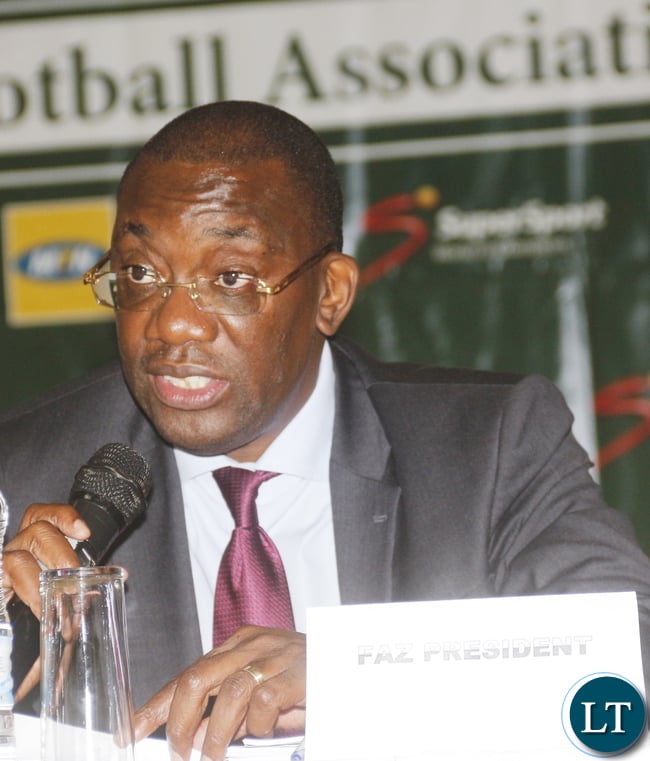
The Football Association of Zambia (FAZ) has thanked President Hakainde Hichilema for his gesture to find time to interact with Scottish based Chipolopolo soccer player, Fashion Sakala on his visit to Glasgow.

FAZ President Andrew Kamanga says his executive is elated with the gesture made by President Hichilema, who is also patron of the Football Association of Zambia.

Kamanga says the FAZ executive committee, and the entire football family is extremely humbled by the gesture from the Head of State.

“The rare gesture is an affirmation of the recognition of talent from the Head of State and his administration. We have no doubt that this is a signal for our players to aspire for excellence in their respective clubs and national team.” Kamanga said.

Kamanga also paid tribute to Sakala for giving the President an insight of the possibilities that football offers once fully embraced as a career option.

“Fashion Sakala proved a worth ambassador of our game in his interaction, and we hope that other players should learn from his story that is traced from a humble ground. Young people should learn from his example and also borrow from the President’s message for players to invest while they are still playing,” he said.

President Hichilema and Sakala conferred on the side lines of the COP26 Glasgow Conference.

Sakala is one of the many Zambian players flying the national flag in foreign leagues.

This is contained in a statement made available to the media by FAZ Communications Manager Sydney Mungala.

Government is determined to strengthen the existing cordial relations between Zambia and Zimbabwe

2

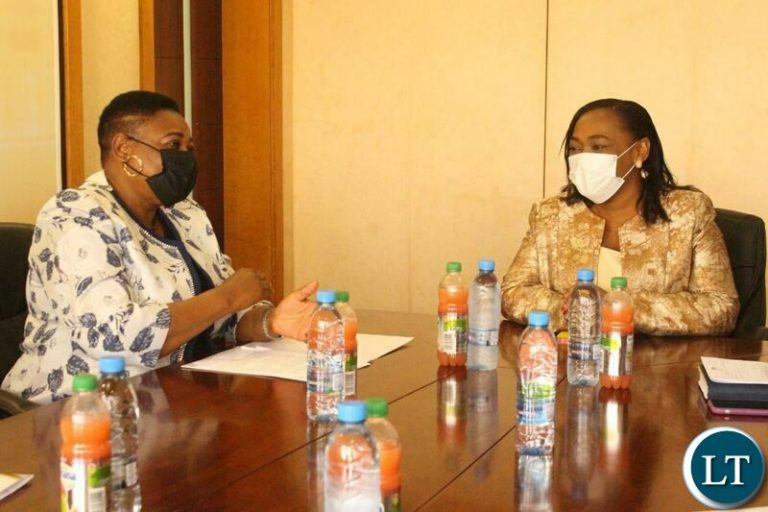
Information and Media Minister Chushi Kasanda has said Government under the leadership of President Hakainde Hichilema is determined to further strengthen the existing cordial relations between Zambia and Zimbabwe.

Ms. Kasanda, who is also Chief Government Spokesperson, said this is important for the mutual benefit of the two countries and peoples.

Speaking when Zimbabwean High Commissioner to Zambia, Charity Charamba paid a courtesy call on her this morning, Ms. Kasanda said Zambia and Zimbabwe have continued to stand together on many fronts aimed at improving the lives of citizens.

“Your Excellency, Zambia, and Zimbabwe do not only share a common border but also a common heritage, and a common future that is anchored on peace and development,” she said.

And Ms. Kasanda has called for close collaboration between her Ministry and the Ministry of Information, Publicity and Broadcasting Services of Zimbabwe to enhance the flow of information between the two countries.

She said this would not only cement the relations but also facilitate the growth of the media and information sector between the two countries.

Zimbabwean High Commissioner to Zambia, Charity Charamba said Zimbabwe will forever cherish the sacrifice made by the Zambian people during that country’s struggle for independence.

Ms. Charamba said there was the need to enhance the bilateral relations which are managed under the framework of the Joint Permanent Commission on Cooperation (JPCC) and the Joint Permanent Commission on Defence and Security Cooperation (JPCDSC).

She said the frameworks are important as they provide platforms for the two countries to strengthen cooperation in various areas such as tourism, culture, education, women empowerment, immigration among others.

And Ms. Charamba has commended Government efforts to provide universal access to media by all citizens especially those in rural areas through the installation of communication towers and radio services around the country.

She said it is gratifying to note that the Zambian government has, in the 2022 budget, made a provision to facilitate this exercise which she said her government had equally embarked on.

PF’s Reaction to UPND 2022 Budget in Full

23

On the 14th of August, 2021, we were told that a new dawn had come to Zambia and we were advised that we should record everything they were promising us and start ticking because the UPND Government would deliver on its promises. This was put even stronger on the 16th August 2021 at the Heroes Stadium.
Following the opening of the first session of the thirteenth National Assembly, we pointed out that the speech of the President had watered down or ignored many of their campaign promises such as:

  1. Free education from Grade one to university education;
  2. Increase in the FISP;
  3. Reduction of cost of fertiliser;
  4. Increase in salaries for Civil Servants;
  5. Reduction of cost of mealie meal;
  6. Avoidance of borrowing and dismantling of national debt; etc.

We were told that it was too early to judge the UPND Government as they were simply completing the 2021 budget they inherited from the PF Government and that we should wait for their own budget.

Fortunately, time never stands still and the 29th October came and their long-awaited inaugural budget had to be presented.

Numerous comments have been made on the budget, some critical and of course some in support. The PF leadership met with PF Members of Parliament last weekend to jointly analyse and adopt a common position on the 2022 budget.

I now wish to present to you our findings which we arrived at after very careful and painstaking probing.

From the outset let me state that the budget in its entirety is a hoax as it is not correct, secondly, it is an illusion as it is not tenable, thirdly it is a façade or a deception as it hides the real intention of its authors and fourthly it is retrogressive as it brings back the many gains that have been achieved, fifthly it is a breach of the fundamental campaign promises upon which the UPND was voted and sixthly and most importantly it is pro-capital and against the poor.
Let me explain.

1. A Hoax: Figures in a budget ought to balance first within the two aspects namely the expenditure side and within the revenue side and between the two aspects. As the nation has already been made aware by our alert MPs in parliament, the 2022 budget has a discrepancy of K37bn on the expenditure side. Why is such an expenditure hidden?

2. An Illusion: The UPND proposes to grow the budget from K119bn in 2021 to K 173bn in 2022 representing an increase of 45% and yet they have proposed increases in consumption and reductions in revenue such as the Mineral Royalty Tax, Corporate Tax, and customs duties. As though this is not enough they have decided to utilise a onetime revenue stream in the form of the Special Drawing Rights (SDR) of $1.2bn to finance recurrent expenditure. We challenge the UPND government to explain how these recurrent expenditures to be financed by this one-time gift shall be paid in 2023 and subsequent years. Has anyone assured them that this gift shall be perennial? We would like to ask the UPND Government how SDR which is meant to be the balance of payment support can be transformed into budget support? As far as we know SDR can only be sued to finance foreign exchange payments outside the country after the government has provided the kwacha equivalent to the Central Bank. As you can see this is an illusionary budget that cannot be implemented.

3. A Façade a deception: There is no cost item that is more widely discussed in the 2022 budget than the Constituency Development Fund. This was poor dramatics attempting to deceive MPs and the general citizenry that there will introduce fiscal decentralisation. First decentralisation, by those of us who understand it is an organic process which is done gradually and systematically to allow for development of capacity and systems to support it. It does not happen like magic – that you get power from the centre and immediately send it to the most peripheral of the development hierarchy. Secondly reading the budget speech critically you will realise that the central government is simply abdicating on its development responsibilities and its fiduciary responsibility. It has passed on numerous central government responsibilities to Constituencies without taking into account the lack of capacity in the constituencies. Actually the financial burden passed on to the constituencies outstretches the K 25.7m by leaps and bounds. It is a clear deception aiming at passing blame for government failure to MPs.

If spending K1.6m was such a time consuming process marred with irregularities as have been reported by the Auditor General’s reports, what will happen with K25.7m and with increased scope? We have therefore directed our MPs to educate this government on the history and rational of the CDF. Now that MPs are going to superintend over and get directly involved in the implementation of government projects who shall perform the oversight function? This move is contradictory to the dictum of separation of power and must be stopped to curtail the intentions of diluting effectiveness of Parliament in its oversight role.

4. A retrogressive budget: The PF government optimised the mine tax regime making it possible to collect taxes in excess of $600m for the year 2021. Our mining tax regime saw mining companies post profit and pay taxes to the benefit of the Zambian people. Now the UPND has made MRT deductible rendering that no mining company shall pay any taxes at all. Zambians have been denied an opportunity to benefit from their God given resource at a time when the copper process are at their highest in the history. What a retrogressive regime?
As though this were not enough, the UPND has decided to reduce corporate tax from 35% to 30% with an eventual revenue loss of K 600m in 2022 alone. To add salt to injury the UPND government has also decided to do away with customs duty on the export of maize. I will address all these matters in more detail a little later.

5. Breach of fundamental campaign promises: The UPND won the 2021 elections on a number of promises that they made to the Zambian people. Most fundamental among them was debt management. They criticised the PF government on the debt we had contracted. They promised that they will be frugal and will not borrow but will instead pay back debt to make it sustainable. Shockingly if not insultingly we see a direct breach of the confidence the Zambian people riposted in this regime. Whereas the PF government borrowed $11bn in 10 years an average of $1.1bn per year, this regime in only one year shall borrow $4.6bn. This is against the campaign gibberish from their President who stated that we had reached the ceiling in borrowing and we could borrow no more. Truth be told, Zambians voted on the basis of well-orchestrated deceit – ‘ba na ti gona’. At this rate and with the desire to fulfil their lofty promises, this regime will have borrowed $23bn in five years’ time. This is double what we borrowed in 10 years.

What is striking and saddening is that there is no mention in the budget speech of how this regime intends to handle the aromatization of the first Eurobond which falls due next year. The Minister should have spent some time explaining this matter rather than hiding in the name of donors and the IMF.

The other fundamental promise was free education from nursery to university. Shockingly this has been only for Secondary schools because as the Minister of Finance himself acknowledged Primary education has been free even under the PF government. What has happened to the promise to our university and college students? Where are the much talked about meal allowances?

We have all woken up to the rude reality of voting for a deceitful government which has the greatest tenacity to breach its promises.

We urge the citizens to read the budget and compare with the numerous campaign promises that were made by the UPND.

6. Being pro-capital and anti the poor: In 2011, the PF government doubled salaries of all civil servants and introduced minimum wage structures to ensure that there was more money put in the pockets of citizens employed by the government and the private sector. In addition, we increased the tax free threshold from K 1,000 to K 4,000 to ensure that we reduced the tax burden on individuals and on households. We did this because we are pro-poor in our policies and we pledge to continue being so.

Conversely, the UPND having been nurtured by capitalists have done the exact opposite, exactly as we had tried to explain to the Zambian people. This regime has increased the tax free threshold by a meagre K 500 which translates in savings of only K 50!! At the same time there have reduced standard corporate tax from 35% to 30% and have made Mineral Royalty Tax deductible thereby introducing a revenue loss of more than $600m (more than K 10.2bn) in 2022 alone. This amount given to capital owners is almost double what this regime is allocating to Social protection through Social Cash transfer (K3.1m), Public Service pension fund (K2m) and Food Security Pack (K1m). This is money they are putting in the owners of capital at the expense of the poor Zambians. Going further, this regime has decided to subsidise the export of maize to the eventual benefit of the importers by removing 10% export duty on maize. Their promise to reduce the price of mealie meal is to be fulfilled in the DRC which imports maize from Zambia. How will this increase the price of maize to the poor small scale famers? How many small scale famers export maize? Rather than encouraging value addition on maize by maintain the 10% customs duty this measure shall encourage the setting up of milling plants in the countries that import maize from Zambia. As such this regime is exporting the much needed jobs.

At a time when the world is grappling with climate change, this regime has decided to make the production of plastics more lucrative by removing 5% duty on the importation of filler masterbatch which is used in the manufacturing of plastics.

Note that whereas the PF government was constantly narrowing the gap between the revenues collected from individuals and from corporations, this regime is to collect K17bn from PAYE as opposed to K16bn from Company Tax!!! The individuals are paying more to run the government than the businesses.

As though this is not painful enough, the UPND government is threatening to increase the cost of both electricity and fuel by introducing cost-reflective tariffs. One wonders how small, medium enterprises shall thrive with high costs of production.

Let me conclude on the most vexing issue of Mineral Royalty Tax.

MRT is not a fee it is a tax which is paid as a final tax by both profitable and loss making mining companies. It is a form of rent paid for mining the mineral resource.
Over the 25 years only Kansanshi and Kalumbila have been declaring profits and paying MRT and company income tax. With this reckless concession the UPND government has given to mining companies, even these two mines will stop paying tax. This will lead to the others such as Lumwana and Lubambe which are at the verge of making profits to also not pay tax simply because MRT will now be tax deductible. This is a scandal especially at a time when prices of copper are at the highest and should have benefited Zambians. Are we losing this money for having elected a government that is puppets of capital? For how long shall foreign direct investors call the shots and continue to milk the poor Zambian children of their blood facilitated by stooges of capital.

We are aware that one of the mining companies has sold the cheap story that if MRT is made deductible they will in turn invest $2bn and increase production to 2m tonnes per year. This is the song that you have heard the New Disaster Government signing about.

What the UPND government is ignoring is that there is no law that compels these companies to keep these super profits in Zambia and there is no law that will hold them accountable to invest the $2bn. In any event if they finally do invest the $2bn in Zambia after having gone away with super profits as a result of not paying MRT does it not follow that it is the Zambians who will have invested on behalf of the mining company? What Zambians ought to know is that the mining companies are aware that collecting tax from mining profits is more complicated than collecting MRT.

Zambians, you are hereby called upon to ask the following questions among others about the 2022 budget:

  1. Why are you giving mining companies Tax holidays when the price of copper Is at its highest?
  2. How many companies are to benefit?
  3. What are their political connections?
  4. Why is the budget not balancing?
  5. How do you expect to raise K173bn to finance the budget when you are giving concessions to your business friends who have money at the expense of the poor?
  6. When shall you start delivering on your promises?
  7. When shall you apologise to the PF for castigating us for borrowing at a rate of $1.1 per year and yet you are borrowing at a rate of $4.6bn per year?
  8. When will you apologise to Zambians for lying that you inherited empty coffers?
  9. When will you stop the blame game of condemning the PF for your every failure?
  10. When will you come clean on the fact that you did not come to fix the economy as you purported because by all your actions you are fixing the Zambian people?

PF Slams UPND Budget, the 2022 Budget is Pro Capital and Against the Poor

37

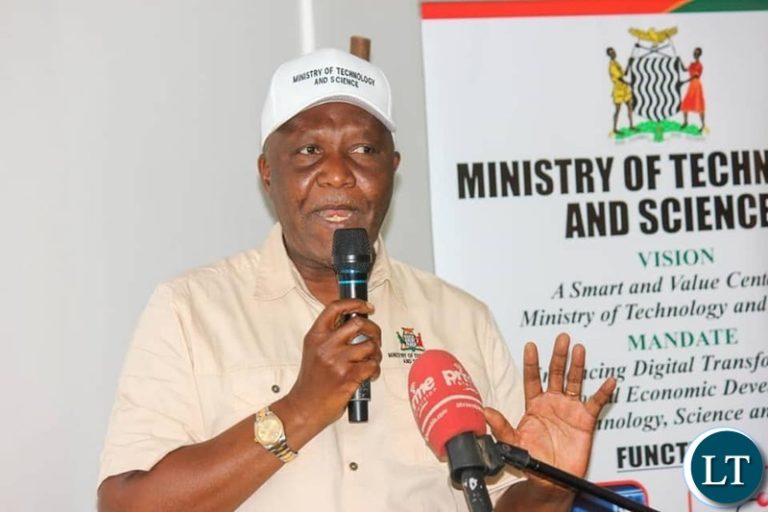
The former ruling Patriotic Front (PF) has said that the United Party for National Development (UPND) budget presented to parliament last week, in its entirety, is not only a hoax but also an illusion that is not tenable and a deception hiding the real intention of its authors.

Speaking at a media briefing today, the party’s Vice President Given Lubinda further said that the 2022 budget is retrogressive as it rolls back the many gains that have been achieved and are a total breach of the fundamental campaign promises upon which the UPND was voted.

Mr. Lubinda said that most importantly that the 2022 budget is pro-capital and against the poor.

Mr. Lubinda said that the figures in a budget ought to balance first within the two aspects namely the expenditure side and within the revenue side and between the two aspects and as the nation had already been made aware, the 2022 budget has a discrepancy of K37bn on the expenditure side and question why such expenditure was hidden.

Mr Lubinda also wondered the drastic increase of the budget from K119bn in 2021 to K 173bn in 2022 representing an increase of 45% and yet UPND have proposed increases in consumption and reductions in revenue such as the Mineral Royalty Tax, Corporate Tax, and customs duties.

“As though this is not enough they have decided to utilise a onetime revenue stream in the form of the Special Drawing Rights (SDR) of $1.2bn to finance recurrent expenditure.

“We challenge the UPND government to explain how these recurrent expenditures to be financed by this one-time gift shall be paid in 2023 and subsequent years.

“Has anyone assured them that this gift shall be perennial?” he asked.

Mr. Lubinda said that this was is an illusionary budget that cannot be implemented.

“We would like to ask the UPND Government how SDR which is meant to be the balance of payment support can be transformed into budget support?

“As far as we know SDR can only be sued to finance foreign exchange payments outside the country after the government has provided the kwacha equivalent to the Central Bank, he said.

Mr Lubinda accused UPND of being anti-poor by increasing the tax-free threshold by a meagre K 500 which translates in savings of only K 50 and at the same time they have reduced standard corporate tax from 35% to 30% and have made Mineral Royalty Tax-deductible thereby introducing a revenue loss of more than $600m (more than K 10.2bn) in 2022 alone.

“This amount given to capital owners is almost double what this regime is allocating to Social protection through Social Cash transfer (K3.1m), Public Service pension fund (K2m) and Food Security Pack (K1m).

“This is money they are putting in the owners of capital at the expense of the poor Zambians. Going further, this regime has decided to subsidise the export of maize to the eventual benefit of the importers by removing 10% export duty on maize.

“Their promise to reduce the price of mealie meal is to be fulfilled in the DRC which imports maize from Zambia.

“How will this increase the price of maize to the poor small scale famers?, he asked.

Mr Lubinda wondered how many small scale famers export maize and said that, rather than encouraging value addition on maize by maintain the 10% customs duty this measure shall encourage the setting up of milling plants in the countries that import maize from Zambia and accused UPND of is exporting the much-needed jobs

Salma Sky unveils highly anticipated new single ‘Free’

Salma Sky released the video for her highly anticipated new single ‘Free’ that features LT Mojo.

Directed By: Tivo Shikapwashya

Music Produced By: Mae N Major

Vocal Production By: Tivo Shikapwashya

ZANEC happy with proposed teacher recruitment

0

Zambia National Education Coalition (ZANEC) is happy with the government’s resolve to recruit 30,000 teachers, as indicated in the 2022 national budget.

In a statement to ZANIS, ZANEC Executive Director George Hamusunga says the move will help improve the teacher-pupil contact time and eventually advance learning outcomes.

Mr. Hamusunga is expectant that the recruitment will be done in the first quarter of 2022.

He said his organization will closely monitor the recruitment process, to ascertain whether the said teachers will be deployed to places where they are required the most.

Mr. Hamusunga called for equitable recruitment and deployment of teachers, across early childhood education, primary and secondary education.

The ZANEC Head is hopeful that government will sort out any challenges that may arise from the payroll, following the recruitment.

“Our hope is that government will remove the constraints posed by the Payroll Management and Establishment Control (PMEC) system in taking teachers where they are required the most. We also hope to see the equitable recruitment and deployment of teachers across early childhood education, primary and secondary education,” Mr Hamusunga said.

And Mr. Hamusunga says the decision to make education free at the secondary level is highly commendable.

“The abolishment of tuition fees, Parent and Teachers Association (PTA) fees, and examination fees at secondary school level is also a step in the right direction as it will significantly reduce the high school drop-out rates that have been recorded in the past as learners’ transition from primary to the secondary school level,” he said.

Mr. Hamusunga however expressed disappointment with the reduced share of the education sector budget from 11.5 percent in 2021, to 10.46 percent in 2022.

The government has allocated 18.1billion kwacha out of the 173 billion 2022 national budget to the education sector.

Zambia, IMF to restart virtual talks on bailout package tomorrow

7

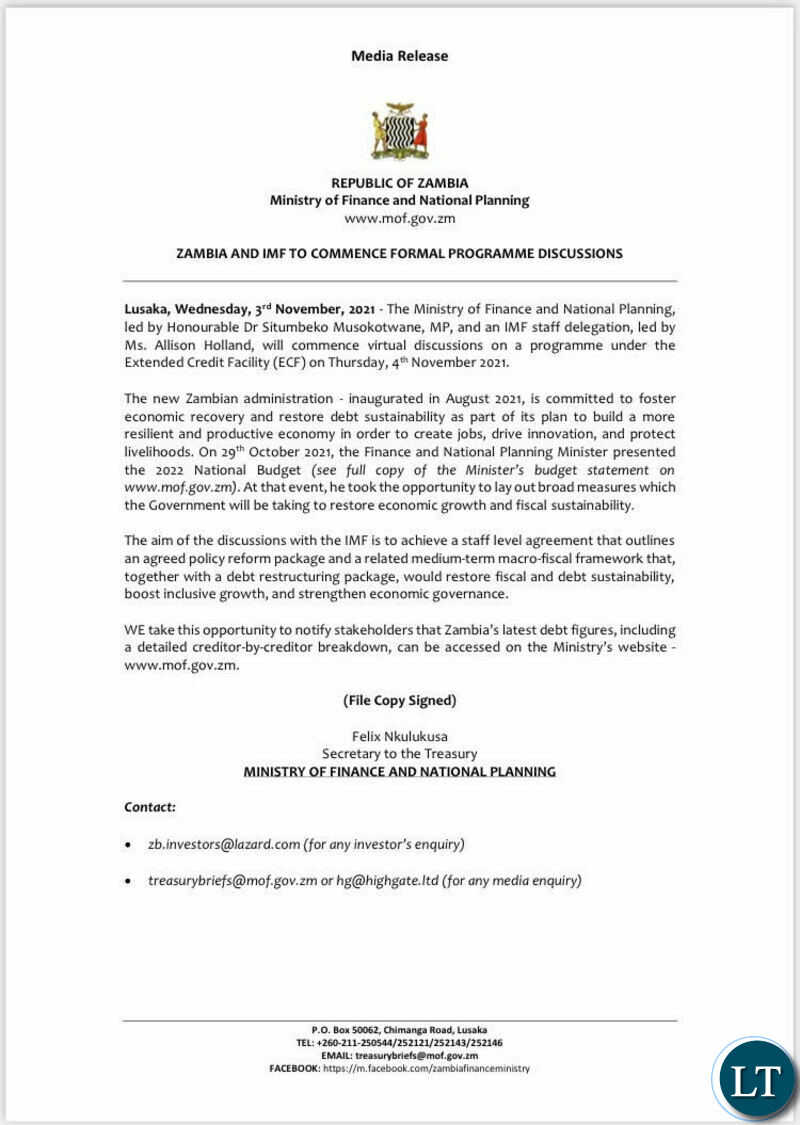
The Zambian government has confirmed that it will commence Virtual Discussions on a Programme Under the Extended Credit Facility on 4th November, 2021.

Ms. Allison Holland will lead the IMF delegation while Finance Minister Situmbeko Musokotwane will lead the team from Ministry of Finance.

The aim of the discussion with the IMF is to achieve a staff-level agreement that outlines an agreed policy reform package and a related medium term macro-fiscal framework that would restore fiscal and debt sustainability, boost inclusive growth and strengthen economic governance.

This is according to a statement issued by Secretary to the Treasury Felix Nkulukusa.

Mr Nkulukusa also announced that Zambia’s latest debt figures including a detailed creditor by creditor breakdown can be assessed on the Ministry’s website www.mof.gov.zm

Below is the full statement

Water Resources Management Authority happy with Revised Borehole Application and Registration Fees

6

Water Resources Management Authority (WARMA) says it welcomes government’s decision to realign the borehole application and registration fees for domestic users.

Stating that the gesture is of goodwill to the Zambian People, the Authority says it is obliged to support government’s efforts of improved access to clean, safe drinking water and sanitation services as stipulated in the Water Resources Management Act NO. 21 of 2021.

WARMA Public Relations Officer Mubiana Nalwendo saying in a statement last evening that the Authority has applauded the upward adjustment in the 2022 budgetary allocation to the water and sanitation sector.

Mr Nalwendo stated that the adjustment is another indication of governments devotion to supporting the country’s socio-economic growth for the benefit of all Zambia.

“The budgetary allocation which we describe as significant in actualizing our mandate, comes at the right time when WARMA is in the process of formulating its 2022 to 2026 Strategic Plan.

“ The upward adjusted budgetary allocation to the sector will aid the authority in accelerating the attainment of the National Vision 2030 and targeted Sustainable Development Goals,” he said.

He noted that the increment will re-energize the Authority’s long-term commitment of promoting a dynamic, integrated, participatory and multi-sectoral approach to water resources management and development.

Mr Nalwendo further congratulated President Hakainde Hichilema and his administration for a successful all-inclusive budget preparation and subsequent presentation for the year 2022.

He explained that the 2022 budget clearly indicates governments commitment to embarking on a steady trajectory of economic recovery.

He added that the budget’s theme ‘Growth, jobs and taking Development closer to the people’ gives hope to the agenda of transforming the country’s economy and placing people at the centre of national development.

He further urged domestic water users wishing to drill boreholes must continue applying and registering with WARMA for sustainable management and regulation of water resources.

Mr Nalwendo noted that the Authority will engage and sensitize the public particularly the domestic users on government’s pronouncement, interpretation and expectations.

Anti-Corruption Commission Intercepts and Seizes 47 Trucks of Mukula destined for Export market

10

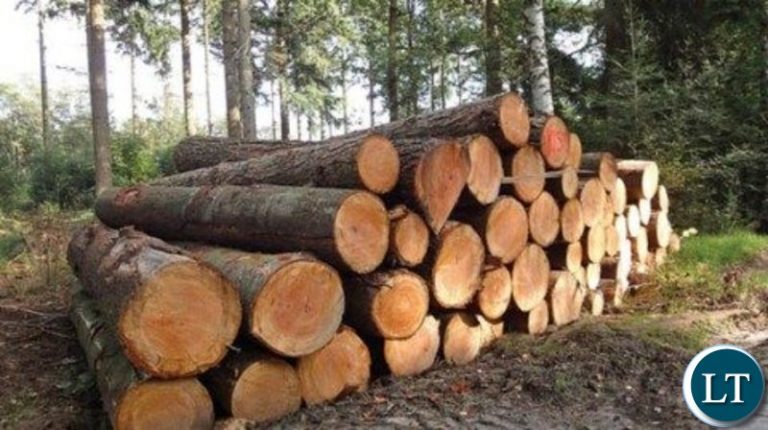
The Anti-corruption Commission( ACC) has intercepted and seized 47 trucks loaded with Mukula tree logs enroute to neighboring Namibia and Zimbabwe, with unknown final destinations.

According to a statement released to the media by the Commission Spokesperson Queen Chibwe, 24 Trucks were intercepted in Mongu on 22nd October, enroute to Walvis bay, Namibia, while 23 Trucks were intercepted in Chirundu on 27th October enroute to Zimbabwe through Chirundu Border. The 47 trucks were found to have no required documentation to transport the Mukula logs.

The Mukula, which was being ferried by Trucks belonging to ACK General Suppliers was seized by the Commission, together with the Trucks, in accordance with Section 58 of the Anti-Corruption Act No. 3 of 2012.

“Investigations into the illegal harvesting and transportation of Mukula by some suspected politically exposed persons are still ongoing, ” concluded the statement.

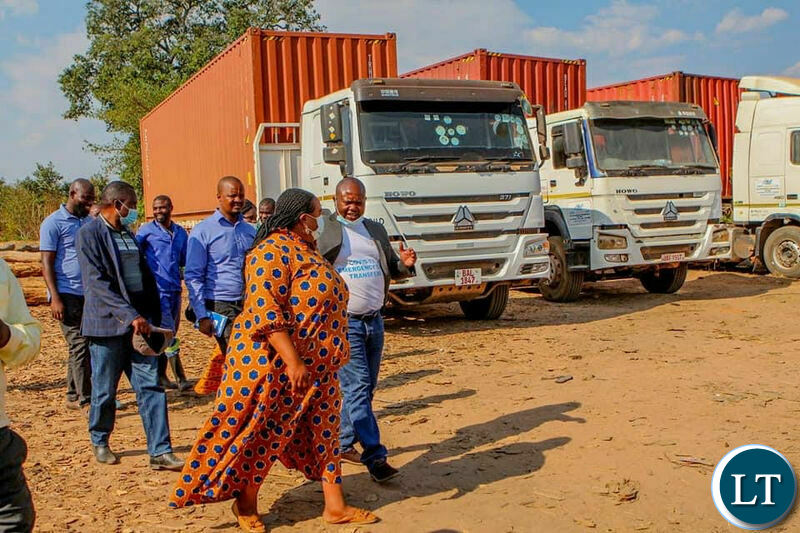
Trucks at the ZAPID Farms awaiting for clearance from the Ministry of Lands.

In September, Minister of Community Development Doreen Mwamba unearthed a scam where a cartel at the Ministry working with some PF officials regime had continued to harvest and export Mukula trees belonging to ZAPID farms.

ZAPID Farms is owned by the Zambia Agency for Persons with Disabilities, a department under the Ministry of Community Development charged with the responsibility to manage Mukula farms in Chipili district in Luapula Province.

During a fact-finding mission conducted by the Mrs. Mwamba, 10 trucks laden with Mukula were discovered at ZAPID Farms while seven other trucks were found packed along the road near the farm.

This was pending forged documentation for Mukula logs to be transported under the pretext they are from Congo.

And the drivers found at the scene explained that they have been waiting for documentation from Congo packed along the road in the bush while the trucks at the ZAPID Farms waited for clearance from the Ministry of Lands.

“For the past two months, the drivers have been waiting for a go-ahead from owners of Mukula trees who are connected to the system,” they revealed.

And Mrs. Mwamba expressed sadness over the indiscriminate cutting down of Mukula trees at the farm.

“This is sad that only a few people from the PF Mukula cartel benefit while the farm remains undeveloped at the expense of the underprivileged. We were getting reports that they are illegal activities at the farm, so we came for a fact-finding mission but what we have found here has shocked us, over 200 truckloads of Mukula have been taken from the farm by the past regime without any written approval from the cabinet,” explained Mrs. Mwamba with shock.

The Minister instructed truck drivers both at the site and on the roadside in Chipili District not to make any movements until investigations from the relevant authorities are concluded.

MID-WEEK PROS HIT LIST: Nsabata Breached, Chibwe Benched

2

The South African PSL resumed on Tuesday following Mondays’ local government elections.

=SOUTH AFRICA

-Baroka FC: Chipolopolo first-choice goalkeeper Mwenya Chibwe was on the bench in Baroka’s 2-1 away loss to TS Galaxy.

-Sekhukhune United: Goalkeeper Toaster Nsabata conceded his first goals after keeping a clean sheet in 270 minutes when Sekhukhune United lost 2-1 away to Orlando Pirates.

-SuperSport United: SuperSport United striker Gampani Lungu was substituted in the 63rd minute of their 2-1 away loss at Real Kings but he was not on target.


-Kaizer Chiefs/Stellenbosch:
Chiefs striker Lazarus Kambole was an unused substitute in their 1-0 home loss to Stellenbosch.
Veteran midfielder Nathan Sinkala played the full 90 minutes for Stellenbosch.


=DENMARK

On Monday in the Danish second division, midfielder Lubambo Musonda started for AC Horsens in their 2-0 away loss at HB Koge before he was substituted in the 84th minute.

Excitement on CDF; case of placing a fattened calf before a pack of hungry wolves!

8


By Prince Bill M. Kaping’a Political/social analyst

INTENTIONS by the ‘New Dawn’ administration to pump in a staggering K25.7 million into the Constituency Development Fund (CDF) from the initial, embarrassingly paltry, K1.6 million, as pronounced in the ambitious national budget unveiled on the floor of the house by Finance Minister & Development, Situmbeko Musokotwane, have obviously elicited conflicting statements from various stakeholders. We are not perplexed at all!

Always keen to be seen to be alert, and working in the eyes of the media, Kabushi Member of Parliament Bowman Lusambo was undoubtedly the first to fire a salvo! While insisting that the K25.7 million was not adequate to deal with all the challenges that the budget has added, the outspoken lawmaker from Kabushi intimated that his constituency only has three members of staff comprising a secretary, security and an administrative officer and none had capacity to dispense the K25.7 million.

In no time, Green Party leader, Peter Sinkamba, joined the fray declaring that his party is least expectant about the increment of CDF owing to the fact it has been an access of corruption and abuse in the past. “Even if the funds are increased but nothing is done to ensure accountability and transparency, it will not yield desirable results,” he said in an interview with a Lusaka based tabloid.

And speaking with Daily Revelation, Col Panji Kaunda warned that a repeat of what used to happen in the PF, where ministers, members of parliament, other leaders and cadres became tenderpreneurs, seeking and easily winning contracts and sometimes registering companies through different names to win projects, must not be allowed to happen again, especially with the hive of activity that will be happening at constituency level.

The Zambia United Local Authorities Workers Union (ZULAWU) president, Emmanuel Mwansa, equally added his voice to the debate suggesting that the increase in CDF for 2022 will require amendments to a number of pieces of legislation which include the constituency development fund act to enhance accountability.

On the other hand, our beloved President Hakainde Hichilema, aka Bally, insists that his government will take money away from a small number of “big thieves” in Lusaka and disburse it to provinces and constituencies to enhance development.

We concur with the President in totality! We can’t continue to have a situation whereby a clique of individuals in Lusaka keep on ‘chewing’ money meant for development on their own. And if at all, by any stroke of fortune, some of this ‘change’ must be invested in some projects; then they must go on a frenzy putting up flyover bridges, roads, schools and shopping malls everywhere in Lusaka, leaving out Lwatembu my village!

While it’s important to appreciate that the good intentions of our President may be commendable, it’s equally important to realize that there may be a few individuals with evil intentions still lurking out there.

If no measures are taken to tighten some loose bolts and nuts that may prompt financial leakages, just know we may have placed a fattened calf before a pack of hungry wolves! In no time, you will see them enjoying life of opulence living in grand mansions, driving expensive SUVs and sending their kids to elite schools if not investing in pondos!

But how best can we avoid plunder of such precious resources?

In accordance to the revised local government Act 11 of 2018, the CDF Committee shall consist of part-time members appointed by the Minister as follows:

5. (a) Two community representatives nominated by the MP from the constituency;

(b) Three councilors in the constituency, two of whom are elected by the councilors in the constituency and one of whom is nominated by the MP from the constituency;

(c) One representative of a chief where a constituency has one chief or two representatives of chiefs where the constituency has two or more chiefs, nominated by those chiefs from within the constituency;

(d) A representative of the director responsible for planning at the local authority in which the constituency is located;

(e) A representative of the director responsible for works or engineering services at the local authority in which the constituency is located;

(f) A representative of a civil society organization operating in the constituency nominated by the MP from the constituency;

(g) A representative of a religious organization in the constituency nominated by the MP from the constituency;

(h) The MP from the constituency; and

(i) A representative of the director responsible for finance at the local authority in which the constituency is located.

If indeed such safety measures have been in force since 2018, how come rampant abuse of CDF has continued, unabated? No need to pretend, some MPS, Council officials and chiefs have been complicity in stealing this money. Would we desire this continues?

Katuba Member of Parliament, Mwabashike Nkulukusa claims he has initiated the establishment of a nine-member committee which will drive the developmental agenda of the constituency.

M. Nkulukusa says the strategic development plan will focus on five key sectors of constructing hospitals, schools, roads, water, sanitation and hygiene as well as rural electricity connectivity. Perhaps we can learn one or two things from this. Perhaps we can add on a few ideas to help prevent white collar thieves from stealing our money.

The office of the district commissioner is supposedly the eyes and ears of government – the President in short! In other words, a DC is supposedly a small president in a given district who is expected to better understand the manifesto of the party in power and be eager to implement the same without any qualms! To this send we would like to propose that the DC’s office must be equipped with the necessary tools to oversee and monitor the implementation of projects under CDF and report to cabinet office accordingly.

Ultimate Insurance Company court case adjourned again

0

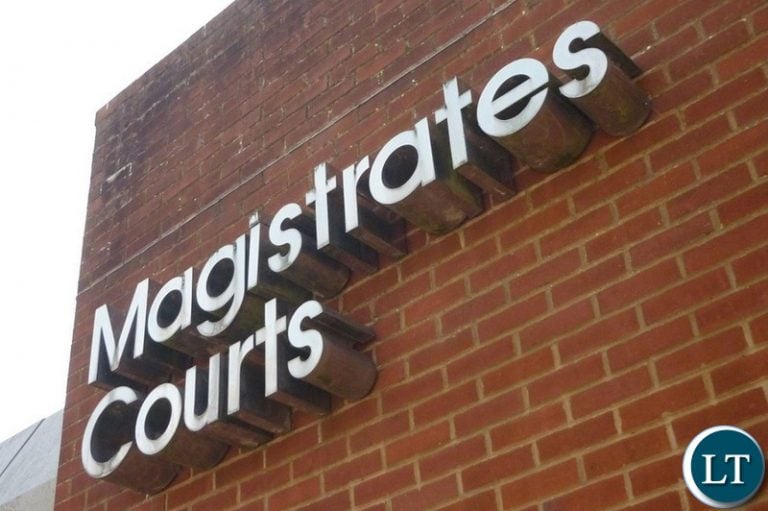
A case in which three Marshlands Consortium Directors and the company are charged with 15 counts of forgery, obtaining money by false pretenses and uttering false documents, among them Ultimate Insurance Company Limited shareholder resolutions yesterday failed to take off
because one of the accused Directors was not before court.

The matter was scheduled for continued trial and alleged owner of the Insurance company, Felistus Chibamba was supposed to explain how the company was allegedly grabbed from her.

Tobias Milambo, a Chartered Insurer of Woodlands, Nachi Musonda of Chongwe and Richard Lubemba, of Chalala are alleged to have forged documents purporting to show that they had been appointed as Directors at Ultimate when infact not.

It is further alleged that between the same dates, Milambo, Musonda, Lubemba and Marshlands Consortium Limited obtained goods by false
pretenses and stole more than US$41, 000 belonging to Ultimate.

However, when the matter came up yesterday, only two of the accused persons, Milambo and Musonda were before court as Richard Lubemba, the other accused person was indisposed.

Lubemba through his lawyer Osbourne Ngoma filed into court a notice seeking for permission to be excused from attending court as he was writing his mid term exams from November 1, 2021 to November 4, 2021 at ZCAS University.

So far, several witnesses have testified in the matter with Luapula
Member of Parliament (MP) Augustine Katotobwe telling the court that he bought the Insurance company for his wife Felistus from the previous owners through connections with Musonda who is one of the accused persons.

Magistrate Alice Walusiku adjourned the case to December 7, 2021.

Zambia launches Structural Vulnerability Assessment and Resilience Strategy

1

The Government of Zambia has launched the Country Structural Vulnerability Assessment and Resilience Process (CSVRA).

The strategy is expected to enhance national resilience and responsiveness to various structural vulnerability factors that can impact on Zambia’s stability, security, and development

Supported by the African Union Commission (AUC) and COMESA Secretariat, the CSVRA is designed to facilitate the identification of a country’s structural vulnerability to conflict at an early stage.

Zambia volunteered to undergo the CSVRA process through a Cabinet Memo submitted to both AU and COMESA in October 2020.

It focuses on identifying drivers of violent conflict in diverse areas such as socio-economic development, good governance, rule of law, democracy and human rights and in the security sector.

This is in addition to environment and climate change, gender and youth, post conflict peace-building and transitional justice, and reconciliation.

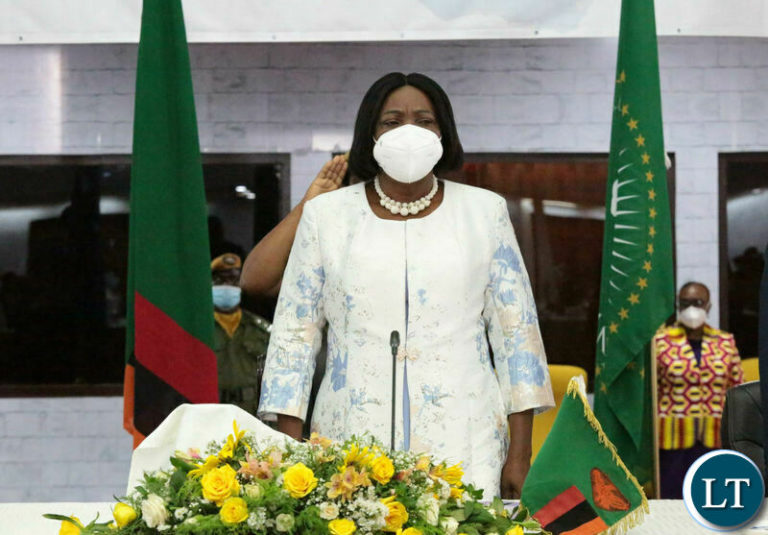
Zambia’s Acting President. Madam Mutale Nalumango presided over the official launch in Lusaka.

“Let this process take Zambia to higher heights in the quest to making the country a beacon of peace and unity, noting that the new dawn government is a continuation of the benefits of democratic processes arising from peaceful transition of power, a timely reminder to Africa and world that Zambia is making strides that are part of the good governance agenda…” noted Mrs Nalumango who is also the Republican Vice President.

She described the CSVRA as one of the ways of creating stability as a catalyst for sustainable development, anchored on local participation especially in areas that are more prone to disasters such as floods and droughts in the country.

COMESA Secretary General Chileshe Kapwepwe described the launch as historic because Zambia is the first country in the COMESA Region to volunteer to undertake this process and only third in Africa after Ghana and Cote dÍvoire.

“…Zambia has continued to show leadership in adopting key instruments on governance peace and stability…for example, Zambia was the second country in COMESA to ratify the African Charter on Democracy, Elections and Governance and among the top ten in Africa to do so,” Ms Kapwepwe point out.

She was represented by COMESA Assistant Secretary General for Programmes Dr Kipyego Cheluget.

African Union Commission (AUC) Senior Political Officer Ahmed Mokhtar described the CSVRA as a unique and home grown Pan African process that seeks to identify and acknowledge structural vulnerabilities, build upon resilience factors and invest in mitigation measures to prevent, manage and resolve conflicts.

It is Member States owned, driven and facilitated. Mr Mokhtar added that the role of the AUC and COMESA is to provide technical support which can be useful in preventing, managing and resolving conflicts.

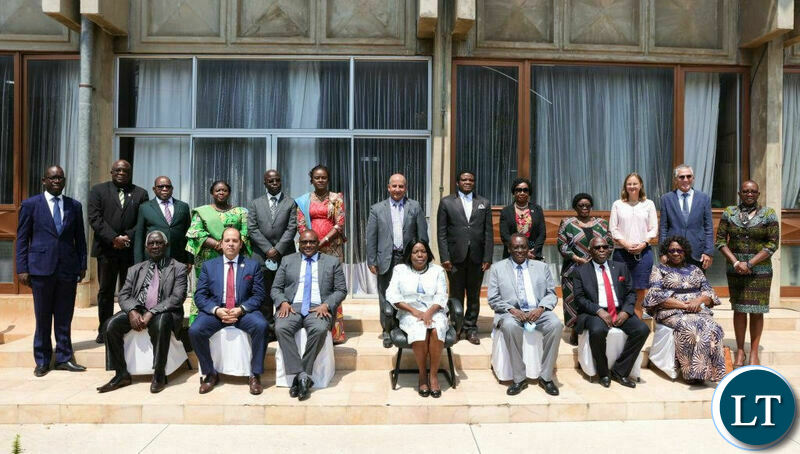
Meanwhile, COMESA Secretariat and the AUC conducted a half-day consultative workshop, Thursday, 28 October 2021 with Permanent Secretaries and senior government officials in Zambia.

The session received presentations on the Ghana and Ivory Coast experiences as case studies.

The two countries have already launched their national strategies to address and mitigate the structural vulnerabilities identified.

Following the CSVRA launch, teams comprised of Zambian stakeholders supported by AUC and COMESA will proceed to hold wider consultations with stakeholders in the provinces across the country.

Various diplomatic coups accredited to the Republic of Zambia and development partners were invited to the event.