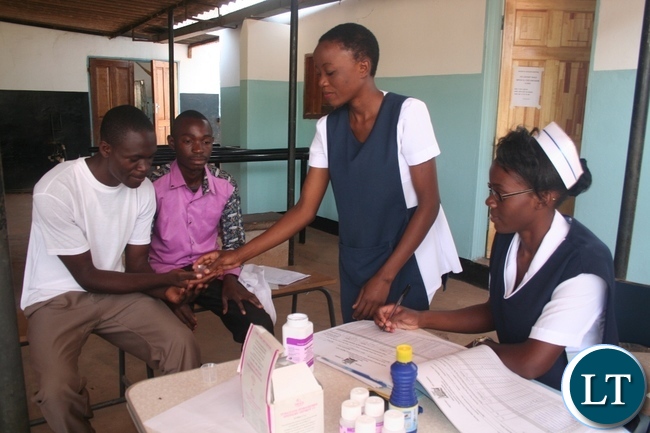
File: Mass drug administration for the elimination of Trachoma
Senior Chief Nkula of the Bemba speaking people in Chinsali district in Muchinga Province has warned parents in his chiefdom who will ignore taking their children for the Trachoma prevention exercise of stern action.
Chief Nkula said the welfare of children should be held with the highest significance with regard to their health, saying all parents who will not adhere to the directive by the Ministry of Health in the district, will face serious consequences.
The exercise follows a report of a threat of an outbreak of trachoma in Shiwang’andu and Chinsali districts.
The Senior Chief sounded the warning yesterday when a team from the District Health Office from Chinsali paid a courtesy call on him to inform him about the three day prevention exercise which will be launched today in Chinsali.
He charged that as an advocate of Children’s rights, he will closely monitor the exercise to see to it that all the children in the area have access to the Trachoma drug.
He said the efforts by the Ministry of Health are welcome and will support them to ensure the effective implementation of the exercise.
Chief Nkula further advised the Health office in Chinsali to provide mobile clinics when carrying out such exercises as they are able to cover a huge number of people in a short time.
He lamented that clinics especially in Chinsali are located in distant areas stressing that access to such urgent facilities may prove to be difficult by the local people.
And speaking on behalf of the District Health Director Dr. David Silweya, Clinical Care Officer Andrew Chulu said some selected schools will be used as health centres for people to have easy access.
Mr. Chulu charged that the idea of using schools as health centres for accessing the trachoma drug will help achieve the 90 percent target of people to be covered.
Meanwhile, Chinsali District Administrative Officer Davie Mulambya who represented the District Commissioner Mr. Maximo Chitambi thanked the Chief for his support.
Mr. Mulambya also appealed to the Chief to inform other Chiefs in Muchinga over the exercise so that they can also create awareness in their chiefdoms.
The programme which is sponsored by Sight Savers Zambia came as a result of a research that was conducted in the area which revealed that a threat of Trachoma outbreak in Shiwang’andu and Chinsali districts is likely to ensue thereby, preventive measures being urgently launched.
Trachoma is a contagious bacterial infection of the eyes that causes swelling on the inner surface of the eye lids and if not treated earlier it leads to blindness.
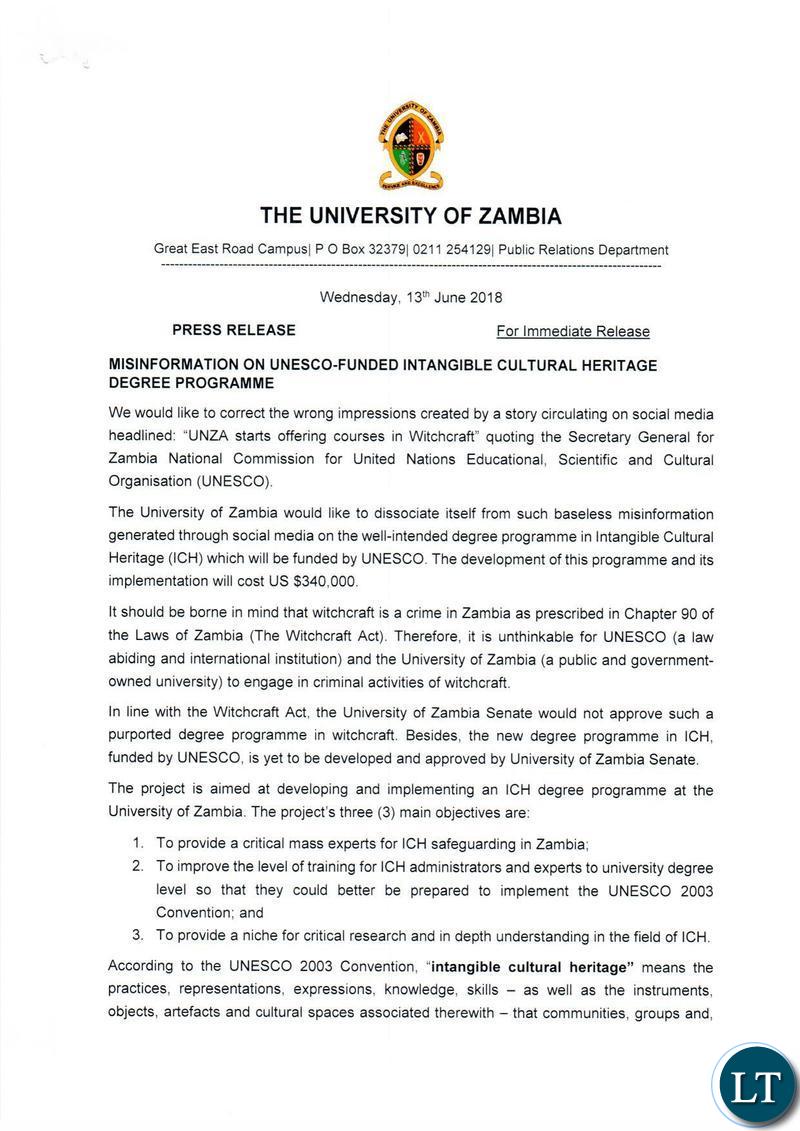
The University of Zambia has dissociated itself from the misinformation generated through social media on the well intended degree programme in Intangible Cultural Heritage (ICH) which will be funded by UNESCO.This is according to a statement issued to the media by Public Relations manager Damaseke Chibale.
Mr. Chibale said Witchcraft is a crime in Zambia as prescribed in Chapter 90 of the Laws of Zambia( The Witchcraft Act.) He said in line with the Witchcraft Act the University of Zambia Senate would not approve such a purported degree programme.The new degree programme in ICH, funded by UNESCO is yet to be developed and approved by the Univeristy of Zambia Senate.
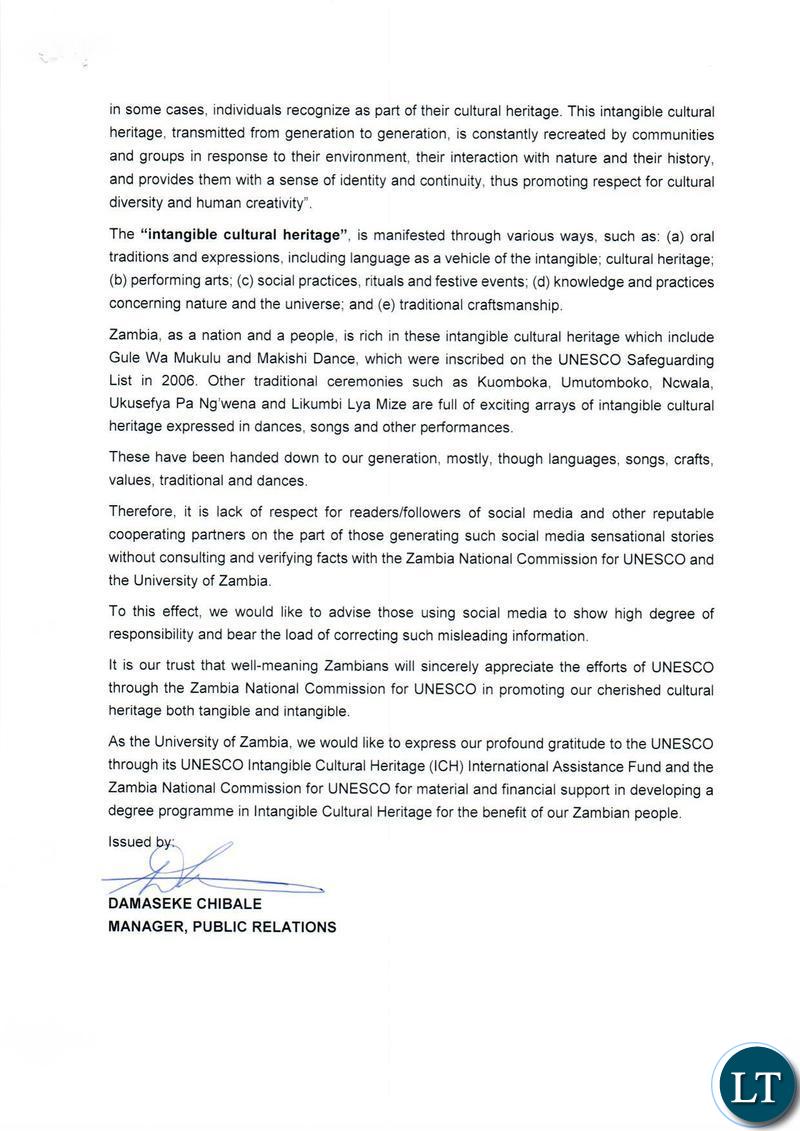
According to UNESCO 2003 convention “intangible cultural heritage” means the practices,representations,expressions,knowledge ,skills – as well as the instruments,objects,artefacts and cultural spaces associated therewith -that communities ,groups and in some cases individuals recognize as part of their cultural heritage.
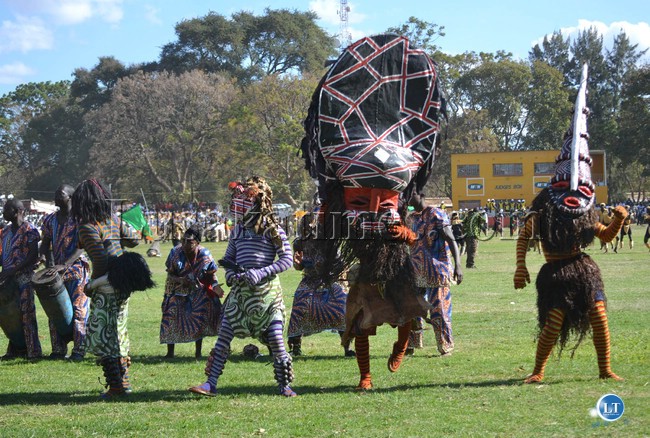
Mr. Chibale said Zambia as a nation and a people is rich in these tangible cultural heritage which include Gule Wa Mukulu and Makishi Dance.
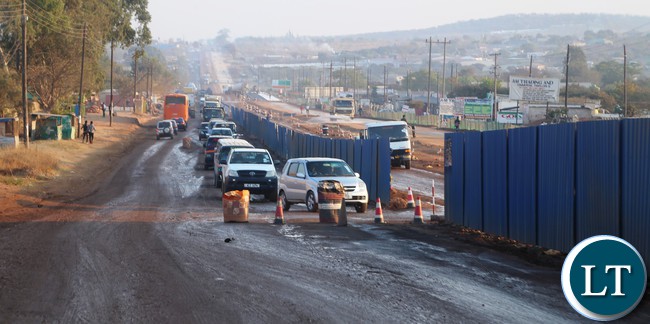
File:Works on progress on the Lusaka-Ndola dual carriageway costing $1.2 Billion in chibombo District
By Trevor Simumba
During the ground-breaking ceremony for the Lusaka-Kapiri-Ndola Dual Carriageway project, the Chinese Ambassador to Zambia stated an old Chinese proverb that goes, “build your roads first if you want to get rich”.
Transportation infrastructure is crucial to the economic and social development of a nation.
Zambia has many favourable natural endowments for its development, however, subject to poor infrastructure, a fair amount of its economic potential cannot be fully tapped.
The project of the Lusaka-Ndola Dual Carriageway was mooted over four years ago as part of the Link Zambia 8000 project and the process of selecting a PPP contractor started in 2015.
In 2015 a Restricted Invitation to Tender was issued by the RDA (Ref: RDA/PPP/CE/001/15). The RFP stated that the RDA, intended to enter into a Public-Private Partnership Agreement in form of a concession to undertake the upgrading of the Lusaka to Ndola road to dual carriageway.
This Request for Proposals (RFP) solicited for financially and technically competent prospective concessionaires to Finance, Design, Construct, Operate, Maintain and Toll the proposed road projects. Below are the original specifications:
1. Lusaka to Ndola (T002/T003) approximately 321 km, including Kafulafuta to Luanshya Town (M006), approximately 45 km;
2. Construction of new carriageway lane road, 6.8m wide with 2.0m wide shoulders, with Grade Separation where required;
3. Median separation (9.2m in rural areas and 2m in urban areas);
4. Service lanes on either side of the road in urban areas with pedestrian traffic accommodation facilities including walkways, cycle tracks, walk-over bridges, etc;
5. 50mm Asphalt Concrete on 200mm crushed stone base and 300mm cement stabilised sub-base or alternative subject to approval by the Client;
6. Construction of two bypasses around Kapiri Mposhi and Kabwe central business districts;
7. Major drainage works – construction of bridges and culverts;
8. Rehabilitation/reconstruction in selected sections of the existing road, with 2.0m wide shoulders;
9. Construction of Toll Plazas at designated toll sites; and
The Bidder was to propose the construction and concession periods, which shall be subject to negotiation. As can be noted from the above this was purely a road upgrading project without all the other added commercial provisions that the Minister highlighted to justify the new high cost of the project.
All the bridges and by-pass roads were already factored into the project costs.
According to the RDA RFP the Economic Internal Rate of Return (EIRR) this road was approximately 29 per cent and the cost of construction was estimated at K930 million.
However, the Minister of Infrastructure and Housing in his Ministerial Statement to Parliament stated that the total contract sum is US$1,245,775,986 (approx. K11.1 billion) which is a huge jump from the original estimated K930 million).
More importantly he stated that EIRR was now 15% and that the contract had been varied and that it was no longer strictly a PPP as the contractor had obtained a loan for the project.
The Minister further stated that the selected financial model has a payback period of seventeen years, with an internal rate of return of 15 per cent. This rate of return is 50% lower than the original one even though the Minister stated that this was a very good rate of return!
The project under the selected model further shows that the project will generate gross revenues of approximately US$3.5 billion over a period of seventeen years after commencement of operations.
Even with the assurances from the Minister public perception of high level corruption in this project persists.
Initially during the Groundbreaking ceremony, it was stated that the Government had obtained a loan of 1.2 billion dollars from China Exim Bank.
This has been confirmed in the RDA 2018 Approved Road Sector Annual Work Plan (RSAWP) that shows a disbursement of K1.4 billion ($147 million = $1.7 million per km of works) for 86 km worth of works for the period covering 2018 and indicates the source of funds as China Exim Bank.
More significantly, the Government of Zambia has provided a sovereign guarantee for these funds which means if something goes wrong the Zambian public will have to pay this debt.
The Minister of Finance in his 2018 budget address stated: “Mr. Speaker, the recently launched Lusaka – Ndola dual carriage way is one of the most critical economic roads. Let me hasten to mention that this project consists of two phases. Phase I will be the construction of the dual carriage way, while phase II will involve the construction of auxiliary infrastructure which includes hotels, toll gates and service stations. Phase I will be financed through Public Private Initiatives while phase II will be financed through private sector participation.”
The question that lingers is why Government is taking all the risk even for the private sector commercial projects on this road and if the internal rate of return is so good why is the Chinese contractor is not able to finance the project without recourse to sovereign guarantees.
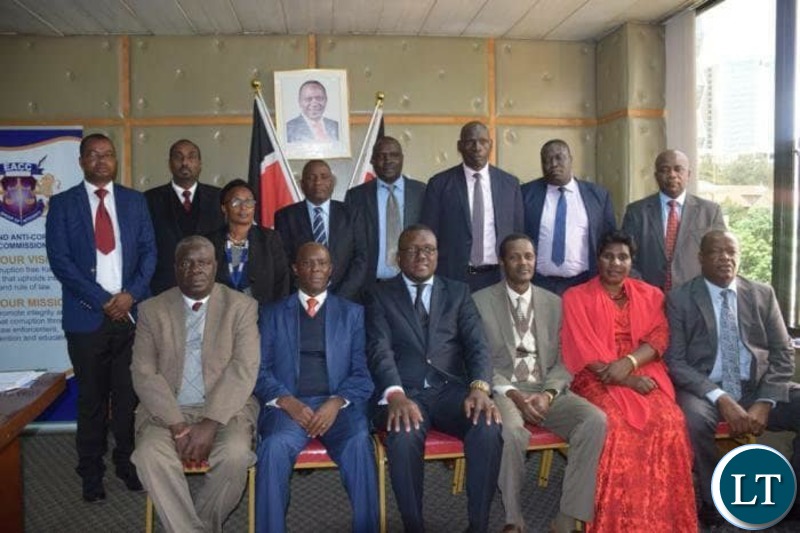
Kenyans on Twitter are reacting to a story in one of the main newspapers that a group of Zambian lawmakers are in the country to get tips on how to fight corruption.
The report says eight Zambian lawmakers from the committee on Privileges, Absences and Support Services visited Ethics and Anti Corruption Commission (EACC) commissioners at Integrity Centre in Nairobi to learn how the agency has been spearheading the war on graft.
The Commission has been constantly criticised for going after “small fish” and ignoring the elites who perpetrate the biggest scams.
An EACC official, Mwaniki Gachoka, is quoted as saying, “We are sharing experiences on fighting corruption and promoting ethics.”
“This is a study tour by our colleagues from the Zambian National Assembly. We are sharing experiences on fighting corruption and promoting ethics,” EACC commissioner Mwaniki Gachoka said.
“We are fighting corruption through many strategies. One of the is law enforcement – investigating cases and recommending them to the DPP.”
Zambian MP Garry Nkombo, who is leading the delegation, said they were studying best practices in managing corruption in governance.
Mr. Nkombo said they will also share their experiences and the problems they have encountered in the fight against the vice and processes in whistle-blowing and prosecution of suspects.
“We recognise the fact that corruption does exist and want to learn how Kenya has been dealing with it. It is generally agreed that corruption cannot be fought with kids’ gloves,” Mr. Nkombo said.
Transparency International lists Zambia as having a lower corruption score in the public sector compared to Kenya.
Kenyan media has been awash with reports of corruption in the government, one the latest being the alleged theft of 8bn Kenyan shillings ($78m; £59m) from an agency set up to deal with youth unemployment.
At least 40 civil servants have pleaded not guilty for their role in the corruption scandal.
A data visualization site recently tweeted a video montage of 40 corruption scandals reported in local media since 2013.
President Uhuru Kenyatta has warned that nobody who is found guilty will go unpunished while the Judiciary has asked agencies and investigators to provide evidence sufficient for convictions.
America Finally Develops a Magical Laser Gun for Drones With Similar Potency And Accuracy to the Kaliloze Night Gun of the Barotseland
Three year ago, I did post on my Facebook Page this write-up. Surprising, it attracted very little attention.
One year on, Professor Nkandu Luo hinted on the need to undertake research into witchcraft. Public reaction was quite negative.
Now, a degree programme has been introduced at UNZA. Public reaction is even worse.
This story I posted, and I re-post, is about Barrie Reynolds, Keeper of Ethography of the Livingstone Museum, now called and the National Museum of Zambia. Sixty years ago, Barrie wrote a small three page article for NADA, the in-house journal of the Southern Rhodesia Native Affairs Department. The story was about a young British police officer investigating a murder and near beheading in the Barotseland Protectorate (present-day Western Province, Zambia). Two women had been murdered with a suspicion of witchcraft attached. The weapon used was a “Kaliloze Night Gun”.
Barrie Reynolds, who had been invited to interview the accused, and to examine the confiscated material used in evidence in the court cases, noted that “a change had recently taken place in the manner in which these weapons were being constructed. These kaliloze guns were fired at the sun, or through a hole in a wall. No physical wound was inflicted. However, death was caused. What caused the death remained a mystery.
In the ensuing government clamp down, an astounding number of people were formally charged and convicted of contravening the witchcraft legislation. No less than nine young men were arrested, sentenced to death, and executed.
Fast forward to 2014, a Laser Weapon System (LaWS) was launched by the U.S. It has similar potency, stunning accuracy, secrecy and the mystery of the “The Kaliloze Night Gun” of Barotseland. But because has been developed by the Americans, no one has been arrested, charged and executed .
The weapon is now mounted on the USS Ponce, an amphibious US transport ship, which has been deployed in the Persian Gulf.
According to news sources last year, the LaWS is “world’s first laser weapon” — one that can “kill” threatening, airborne drones — and is ready for action.
The question is: is LaWS really the world’s first laser weapon?
As indicated above, sixty years ago, the Baroste “laser scientists” had similar weapons, except for want of comprehension of photon and laser science at the time, and such “scientists” were labeled “witches and wizards” and executed.
The new laser weapon, may seem as though it were pulled straight from a James Bond movie, but it is entirely functional, and can shoot with stunning accuracy, according to the U.S. Navy.
“Operationally, it works just like a laser pointer,” Lt. Cale Hughes, a LaWS officer, told CNN. “There’s a chamber inside with special materials that release photons.”
The LaWS laser beam is completely silent and invisible. It’s also fast: The laser travels at the speed of light (186,000 miles per second, or about 300,000 kilometers per second), meaning it’s about 50,000 times the speed of an incoming intercontinental ballistic missile, such as the one North Korea was testing last year, the Navy told CNN.
The $40 million system requires a team of three to operate it and a small generator to power its electricity supply, according to the Navy.
However, each blast is relatively cheap. “It’s about a dollar a shot,” Hughes told CNN.
In addition to being able to take down threats in the air, the LaWS can hit and disable objects in water. The laser’s accurate blasts, heated to thousands of degrees, might even mean fewer casualties in combat, Inez Kelly, a U.S. Naval Forces Central Command science adviser, told CNN.
For instance, if the laser is aimed at an enemy boat, operatives can “take out exactly the engine, and not necessarily damage anything else,” Kelly said.
“That type of precision weapon work is something that you don’t really get with conventional weapons, because there tends to be more collateral damage.”
Under Geneva Convention rules, armed forces are not allowed to use laser weapons directly against people.
The U.S. has pledged to abide by that protocol, Rear Adm. Matthew Klunder, chief of naval research, said in 2014 at a news conference in Washington, D.C.
The U.S. Navy is already developing second-generation systems that might be able to target threats other than drones and water vessels. These missions are classified, but when asked whether the LaWS could shoot and destroy missiles, USS Ponce Capt. Christopher Wells said “maybe” and smiled, according to CNN.
Back to Zambia, first reported in 1906, Kaliloze guns have been “classified” guns used to rid society in western Zambia of witches for much of the 20th Century, and probably for a lot longer before the 1900s. Not surprisingly these magical guns, which are preferably made out of the thigh bones of human beings, attracted the horrified attention of British colonial administrators, and continue to fascinate and frighten people in Zambia in the present.
In the course of the 20th Century the Kaliloze, as a magical weapon, has changed and spread eastwards within Zambia. From the 1970s on wards, the Kaliloze has to a large extent become synonymous with the AK 47 assault rifle when it is used as a Karavina. It appears the science is slowly but suely going into extinct.
One thing for sure, we needed to undertake a serious research to understand and harness the potency and accuracy of this “classified” science using modern science.
You like it or not, the Barotse people were light years ahead of the Americans in terms of laser and photon science. The British imperialists are largely to blame for executing the natives for practicing a science that was way beyond their comprehension.
Perhaps, it is high time we rethink our attitude towards African “classified” science, in particular the science of the Kaliloze Guns, the Magical Firearms used in Western Zambia in the 1950s. I totally support the decision to venture into this science from an academic perspective. This could turn out to be another money spinner for Zambia. Just come to think of Zambia exporting 10,000 “Kaliloze Laser Guns” more potent that the LaWS to the rest of the world each worth than $50 million.
We need to start thinking in that direction…..I mean “Think-Outside-the-Box”.
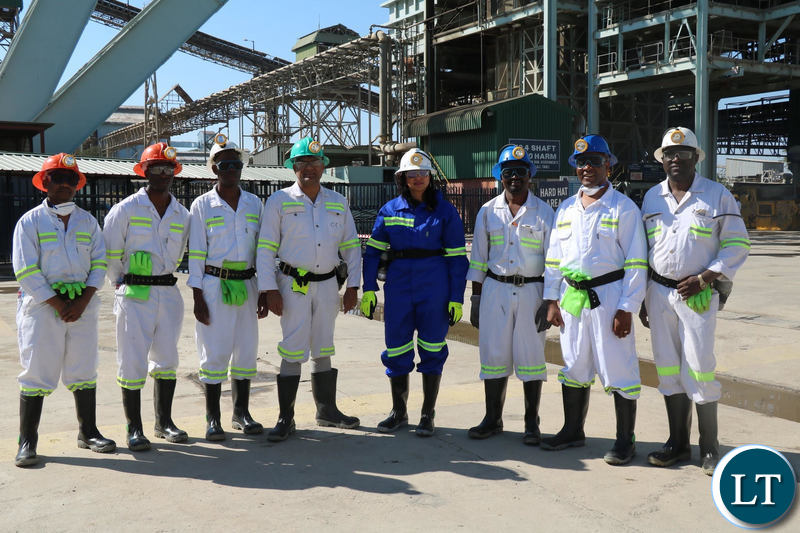
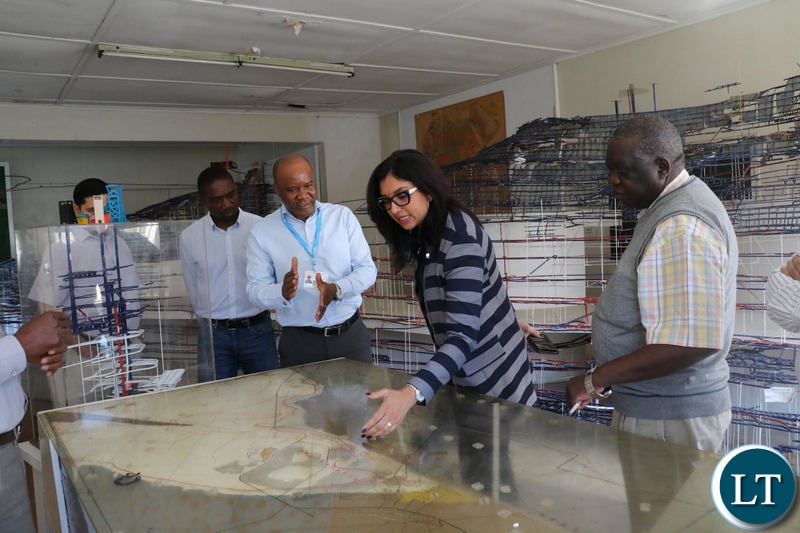
Vedanta’s Africa Base Metals CEO Deshnee Naidoo with the KCM team during her familiarization tour of Konkola underground facilities recently.
Vedanta’s Africa Base Metals CEO Deshnee Naidoo has provided an update on African operations and reiterated that her focus will be to create deeper synergies for the company’s operations in South Africa, Zambia and Namibia to ensure sustainable growth across the region.
Ms Naidoo told journalists in Lusaka that the priority at Konkola Copper Mines (KCM), where she is the new CEO, will be to target integrated copper production at 200,000 metric tones in the current financial year (2018/19) from just under 100,000 metric tones in the previous year.
Ms Naidoo said she would cement the ‘basic building blocks’ set up by the departing KCM CEO Mr Steven Din, in order to produce more copper cathodes in support of the 50-year vision for Vedanta Resources to continue mining for copper in Zambia.
Ms Naidoo commented that, “My job is to stabilise the business at base level, to ensure reliable production and make sure that we can reach the ultimate 400,000 tonnes production level of integrated growth within the next few years”.
“KCM has an attractive orebody and major capital in excess of $3 billion has already been invested. Our strategy with business partners is about creating shared value amongst stakeholders, the employees, the government and the communities”, she said in reference to technical business partners KCM has engaged to assist with mining, water management at the Konkola Deep mine and equipment maintenance in the company.
Ms Naidoo said KCM and the other African operations would continue to mine within a context of environmental protection. The planting of 89,000 trees in the last 13 years in communities and schools in the Copperbelt region and KCM plant areas, and the removal of 500,000 metric tones silt in 2017 from the Muntimpa Dam and streams within Chingola town is the assurance of the KCM Go Green initiatives. The company is also providing fresh drinking water through solar-powered boreholes to over 8,000 people in Chingola.
Ms Naidoo said plans to invest $300 million in a 300-megawatt (MW) coal-fired power plant in southern Zambia were on course following the commencement of a pre-feasibility study. The proposed plant would support KCM growth at the Konkola deep mine, the setting up of a cobalt refinery and other growth projects.
She also said Vedanta Africa Base Metals was looking at constructing another power plant at the Gamsberg project in South Africa’s Northern Cape province.
“In South Africa, we are looking at building a Zinc refinery. Smelters and refineries are power-hungry and so as part of that scope we are looking at a 200 megawatt power plant, it will be an integrated plant, using both renewable energy and coal-fired power” Ms Naidoo said.
Production is set to start at Gamsberg within a month, and the mine should ramp up to full production of 250,000 tonnes annually in about a year.
Giving an update on Skorpion Zinc operations in Namibia, Ms Naidoo said that the option of underground mining at the mine when the company’s open-pit operations become exhausted around 2020 were slim.
“We have drilled it out and it is looking less likely that there will be another underground mine, but the other option is to look at whether after this current push back we can do mining through a decline to extract whatever else we can get,” she said.
“As it stands, we might only extend life for another 2-3 three years through a decline or open pit”.
Ms Naidoo said there were numerous opportunities across Africa Base Metals’ operational geographies to sustain the company and communities in its areas of operations.
Vedanta’s Africa Base Metals CEO Deshnee Naidoo with the KCM team during her familiarization tour of Konkola underground facilities recently.
File:Natasha Salifyanji Kakoma chats with Queen Elizabeth II
Her Majesty The Queen will present Gift Chansa and Sela Kasepa from Zambia with a Queen’s Young Leaders Award at a special ceremony at Buckingham Palace, London, on Tuesday 26th June. The Awards recognise the work that young people from across the Commonwealth are doing to transform lives in their community and beyond.
Gift from Lusaka will receive a Queen’s Young Leaders Award for the work he is doing using his skills as a circus performer to transform the lives of disadvantaged young people in Zambia after co-founding Circus Zambia which provides participants in the township of Chibolya with circus, academic and life skills.
Sela from Kitwe will receive a Queen’s Young Leaders Award for the work she is doing to explore how science, technology, engineering and mathematics (STEM) can help solve some of the challenges faced by her country by applying knowledge gained from her own engineering studies to found and teach on Zambia’s first robotics development team.
Gift, 26, and Sela, 21, were selected following a competitive process involving thousands of applicants across the Commonwealth. Together they join a network of 240 powerful young leaders, from 53 Commonwealth countries, who are driving change to make the world a better place.
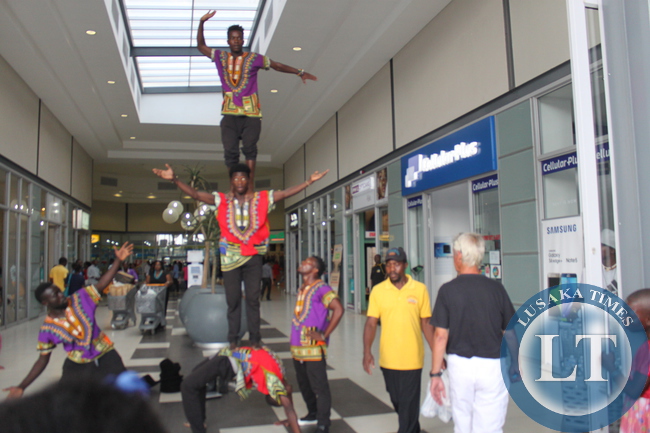
Barefeet Acrobats
The 2018 Queen’s Young Leaders are finding solutions to global issues such as climate change, food scarcity, gender-based violence, mental health, and access to education.
The Queen’s Young Leaders Award winners take part in a year-long leadership course run by the University of Cambridge and receive bespoke mentoring. They will visit the UK for a programme of high-profile networking opportunities, meetings and training designed to help them develop as leaders and work with ever greater impact.
Later this month, during their time in the UK, Gift and Sela will visit 10 Downing Street, take part in masterclasses at the BBC World Service and the UK Headquarters of Facebook. Award winners will then meet with the Commonwealth Secretary-General and High Commissioners from across the Commonwealth, before receiving their Award from Her Majesty The Queen at Buckingham Palace. They will also attend workshops at the University of Cambridge and visit projects that are changing the lives of vulnerable people in the UK.
Dr Astrid Bonfield CBE, Chief Executive of The Queen Elizabeth Diamond Jubilee Trust said:
“Through selfless determination, the Queen’s Young Leaders of 2018 are dedicating their lives to bring positive change to those around them. Their visit to the UK this June provides them with a unique opportunity to connect with each other and gain valuable lessons from experts and leaders from all walks of life which we hope will help transform the reach of their endeavours for many years to come. I am delighted that the work they are undertaking is being recognised by Her Majesty The Queen and I look forward to meeting this year’s winners and celebrating the remarkable difference that they have already made all over the Commonwealth. Now that we are in the fourth and final year of this special programme, we look proudly on the network that is the Queen’s Young Leaders and feel confident that the future will be driven by their courage and commitment towards making the world a better place.”
The Queen’s Young Leaders programme was established in 2014 by The Queen Elizabeth Diamond Jubilee Trust in partnership with Comic Relief, The Royal Commonwealth Society and the University of Cambridge’s Institute of Continuing Education, in recognition of The Queen’s lifetime of service to the Commonwealth.
President Edgar Lungu has declared a three day national mourning for the Late Gender Minister Victoria Kalima who died yesterday.
This is according to a statement issued by Deputy Secretary to the Cabinet for Administration Patrick Kangwa. The late Minister of Gender,Honorable Victoria Kalima died on Monday 11th June at Maina Soko Hospital after an illness.
The period of national mourning will run from Thursday 14th June to Saturday 16th June 2018.During this period, all flags will fly at half-mast and all radio and television stations will play solemn music from 06:00 Hours to 18:00 Hours everyday.
All activities of entertainment in nature should either be postponed or cancelled.The funeral for the late Hon Minister is being held at House number 13 Kasempa road,off Chipushi Road,Sunningdale,Lusaka.
Ruling Patriotic Front Secretary General Mr Davies Mwila has described late Minister of Gender and PF Member of Parliament for Kasenengwa Constituency as a fighter.
“The Patriotic Front knew Hon Victoria Kalima as a fighter. She fought so many battles and overcame. Even when her health started failing her, she remained extremely dedicated to duty, giving all of us hope that she would pull through. She was a critical voice in the Patriotic Front. Sadly the cold hand of death has robbed her from our midst”, Mr. Mwial said.
Mr. Mwila has mentioned that late Hon Kalima will be missed as a strong voice for the people of Kasenengwa Constituency and Patriotic Front in general.
“As Minister of Gender, she ensured that her Ministry occupied its rightful place in fast-tracking the place of the Zambian women in the country’s development aspirations,” he said.
The Patriotic Front Secretary General has since sent a message of condolences to the deceased family and is calling on all members of the Party to join in mourning late Hon Kalima with a sense of unity of purpose.
Ms. Kalima was Minister of Gender and PF Member of Parliament for Kasenengwa Constituency in Eastern Province. She passed away this evening, 11th June 2018, at Maina Soko Hospital in Lusaka.
This is according to a statement issued by PF Media Director Sunday Chanda.
Zambia’s US Dollar-denominated bonds continue to weaken, as the government has still not clarified the debt situation or its fiscal and borrowing plans, according to Exotix Capital.
Stuart Culverhouse, Head of Sovereign and Fixed Income Research at Exotix, said: “Until it does, absent a credible fiscal anchor, we think there is little to stop the bonds falling further. Indeed, the macro situation may get worse before it gets better as domestic financing difficulties mount and inflation risks are skewed to the upside.”
The firm has downgraded its recommendation on Zambia 2027 bonds to Sell from Hold (yield 11.5%).
“Market yields that have now reached 11.5% show the market has lost faith in Zambia and, if there was any confidence back in October that an IMF programme was still possible, this has now all but disappeared,” commented Culverhouse.
“As the government has relied increasingly on issuing domestic securities for financing, absent a Eurobond and an IMF programme, we think non-resident outflows present a further risk to financing and macro-stability, amid already low reserves,” he said.
Culverhouse thinks that a key risk stems from the significant presence of non-resident investors in government securities, who are less stable than domestic investors, and any outflows would put additional strain on reserves and the financing outlook.
Non-resident investors had been attracted by Zambia’s relatively high real yields (carry trade) and have helped the government to cover its domestic financing needs.
Non-resident holdings of domestic government securities were 17.1% at end- March, according to the central bank’s May Monetary Policy Committee statement.
“While not the highest share in SSA (Ghana is nearly 40%), it is significant in absolute terms. It equates to cUS$860mn (at today’s exchange rate), which is c46% of reserves (gross reserves stood at $1.8bn in March, according to the central bank). We are not aware of any signs of non-residents rushing for the exit (either through outright sales or unwillingness to roll over maturities), but if they did, accommodating any outflows, given low reserves (reserves/import cover was c2.1 months in March, according to the central bank), would pose a significant risk to the currency (with echoes of Argentina’s recent LEBAC woes),” Culverhouse said.
“And expectations of a weaker currency (as part of the adjustment process) could lead to non-resident outflows. Lack of further foreign inflows would also strain future financing. It is not obvious that the domestic market could absorb the difference, while resorting to central bank financing would be a negative signal and inflationary,” he added.
Culverhouse said that a crucial test of investor confidence will come at the next scheduled government bond auction on June 29.
“If the auction is undersubscribed (as has been seen in recent T-bill auctions) and/or yields go higher this could signal problems ahead for financing the deficit. Ultimately, this could force the government’s hand, either to take remedial action itself, or return to the Fund for help,” he said.
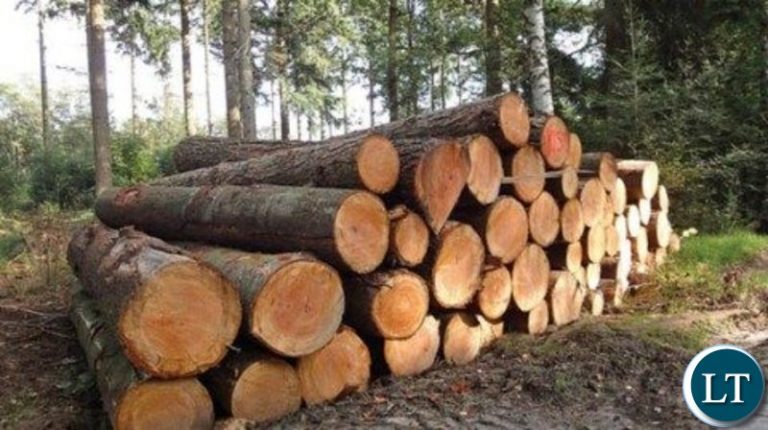
Mukula Logs
A report published by Centre for International Forestry Research (CIFOR) Mukula production and trade in Zambia shows that an estimated US$1.7 million bribes were paid to government officials to facilitate the export of Mukula logs.
The report is entitled the ’Informality, global capital, rural development and the environment: Mukula (rosewood) trade between China and Zambia and the study took 18 months and covered four districts namely Luangwa, Mansa, Mkushi and Kaoma.
It shows that recent Mukula production in Zambia could have amounted to about 110,000 cubic metres (m3) per annum, with revenue losses of about US$3.2 million.
Results of the study also show that rural villagers are increasingly forging direct links with foreign investors, producing innovative business models that accelerate the rate of small-scale production and extraction of resources, all the while still embedded in the rural economic system characterized by legal ambiguity and limited government oversight.
It says as a consequence, such models repeat historical patterns of exploitation with local cutters receiving an average price of about US$23 per cubic metre of timber harvested while manufacturers in China pay about US$1,000–1,100 per cubic metre to importers, before any further processing is done on the exported logs.
The report also observes that across time and along the chain, politics, vested interests and elite capture have left little space for environmental concerns regarding the sustainability of Mukula production or any other species, for that matter.
It shows that in Zambia’s case, the search for Mukula and rosewood more generally has spread across neighbouring countries such as the Democratic Republic of Congo, Mozambique and Malawi over a short period of time, causing havoc in those countries’ natural capital.
It says power hierarchies at all levels of the state and across borders try to benefit as much and as quickly as possible, ultimately hampering the establishment of sustainable businesses.
The report has recommended that the Zambian government must step up its efforts in protecting the Zambian forests and its people’s long-term livelihoods by implementing the innovative measures included in the Forests Act of 2015 regarding community, joint and private forest management.
Tullow Oil
The Centre for Trade Policy and Development has appealed to the Ministry of Mines and Natural Resource Development to give an update on the ongoing Oil and Gas explorations by Britain’s Tullow exploration company.
CTPD Lead on Extractives and Development Mrs. Natalie Kaunda said the Think Tank has noted that since the exploration company was engaged, there has been very limited information flowing through in terms of progress made in this area.
Mrs. Kaunda said CTPD remains keen on finding out how far the Ministry has gone with regards the revision and development of the Act that governs the Oil and Gas sector.
“While we do understand the complexity and nature of the explorations in terms of timings, we think that it would be wise to work around ensuring that the legislation is finalized in a timely manner so as to allow the public and all relevant stakeholders contribute towards shaping the legislation before we get in a phase where we might be talking of extraction possibilities. Admittedly by then Minster of Mines, Mr. Christopher Yaluma when he gave an update on the floor of Parliament, this sector is a new area for this country for which we do not have much capacity,” Mrs. Kaunda said.
She said there is need to develop relevant skills and build the capacity of both the Government and the private sector if Zambia is to develop this sector in a manner that will contribute to the development of the country.
Mrs. Kaunda said this will require more resources and learning from what other countries such as Ghana that has fairly progressive pieces of legislation in place.
“CTPD would like to further appeal to the Ministry responsible for mining to broaden its consultation base if we are to get much from the extractives sector, there is need to improve on the dissemination of information, especially to local communities that are likely to host these extractives investments. We have noted with deep concern from the projects we have been implementing targeting local communities that host mining investments that most of them are left behind when it comes to information in terms exploration activities taking place in their communities, a case in point would include Zambezi and Chavuma Districts, we have learnt that there are a number of exploration activities going on in the districts for various minerals, but few of the local people know.”
She added, “If we are to develop without leaving any one behind as espoused in the 7th National Development Plan, it begins with ensuring that everyone is on the same page information wise.”
JOINT STATEMENT BY CIVIL SOCIETY ORGANISATIONS ON ALLEGATIONS AGAINST SOME JUDGES IN THE SAVENDA Vs. STANBIC BANK CASE AT A PRESS CONFERENCE HELD AT THE FOUR PILLARS LODGE, LUSAKA MONDAY 11TH JUNE 2018
LEADERS OF THE VARIOUS NGOS REPRESENTED,
FRIENDS FROM THE PRESS,
LADIES AND GENTLEMEN,
May I begin by thanking you all, especially you our colleagues from the media for honouring our invitation to attend this very important press conference.
We have called this press conference in view of the serious allegations that have been reported about the conduct of some Supreme Court Judges in the matter of Savenda Vs. Stanbic Bank Zambia. You will note our interest in this matter that as the National Empowerment Forum (NEF), we were created to among other things champion the empowerment of local enterprises.
Our vision is to promote the empowerment of Zambian owned businesses that can generate wealth for the country and create the much needed employment opportunities for the youths. It is against this background that we have in this consortium, youths that are equally adding their voices. Today, our youths are unable to get employment opportunities because the country has basically exported these opportunities in the name of foreign investment.
It is our duty as an organisation to defend and promote local entrepreneurs who are trying hard under very difficult conditions to contribute to the country’s Gross Domestic Product (GDP).
As NEF, we have taken keen interest in the recent Supreme Court judgement involving one local enterprise.
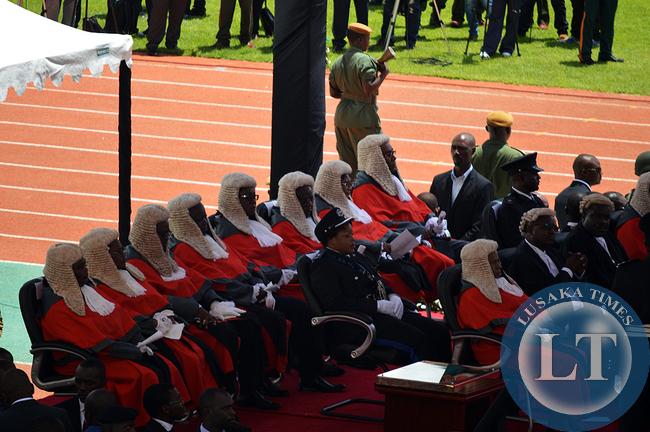
As you may be aware the Supreme Court overturned a decision by the High Court that had ordered that Stanbic Bank pays Savenda K192.5 million. In September 2016, High Court Judge, Justin Chashi ordered Stanbic Bank to pay Savenda K192.5 million for loss of business and vital contracts after Stanbic wrongly and negligently reported Savenda to the Credit Reference Bureau for defaulting on instalments. Stanbic appealed the decision to the Court of Appeals which decided that the damage suffered by Savenda was only nominal.
In March 2018, three Supreme Court Judges, Nigel Mutuna, Michael Musonda and Evans Hamaundu dismissed the appeal by Savenda. The Judges did not only dismiss the appeal but also ordered Savenda to pay Stanbic costs for all expenses the bank incurred from the High Court to the Supreme Court. The Supreme Court said Savenda did not suffer even nominal damages and that Stanbic did not breach any of its duties to Savenda.
While we respect the Judgement of the Supreme Court, we are concerned about the recent reports suggesting impropriate against the Honourable men on the bench.
As a consortium, we are deeply saddened at these media reports as they speak to the country’s justice system. It is in the interest of the Judges and indeed the judiciary to ensure that they come clean against these allegations that have been raised and are playing out in the public.
We do not want to delve into the substantive allegations; however we challenge the Chief Justice Madam IREEN MAMBILIMA to save the Judiciary from an impending embarrassment.
In view of the serious allegations that have been raised against some named Judges, we demand the following;
1. That President Edgar Lungu immediately suspends the named Judges to pave way for the setting up of a Tribunal to investigate the serious allegations.
2. The Chief Justice to immediately constitute a Tribunal to probe the named judges without any further delay.
Any imputation of impropriate, especially corruption has the potential to seriously undermine the credibility of the Judiciary. Zambians have reposed their faith and trust in the Courts to resolve any conflicts and differences, and thus must always be above board. It is only fair that the named Judges should be given the opportunity to defend themselves in the face of the allegations so that this very important arm of Government can maintain its integrity.
We also appeal to the Judges themselves to do the right thing by stepping down to allow for a full investigation.
The Judiciary cannot afford to bury its head in the sand against the damming allegations that have been made against the Judges.
NEF and the consortium members will be writing to President Edgar Lungu to suspend the Judges in accordance with the Constitution so that a Tribunal is set up to probe the named Judges so that they are cleared of the allegations.
As an organisation we will also be writing to the Chief Justice to set up a Tribunal.